
Weather-Resistant Pegboard vs Plywood Tool Walls for High-Humidity Sheds
Introduction
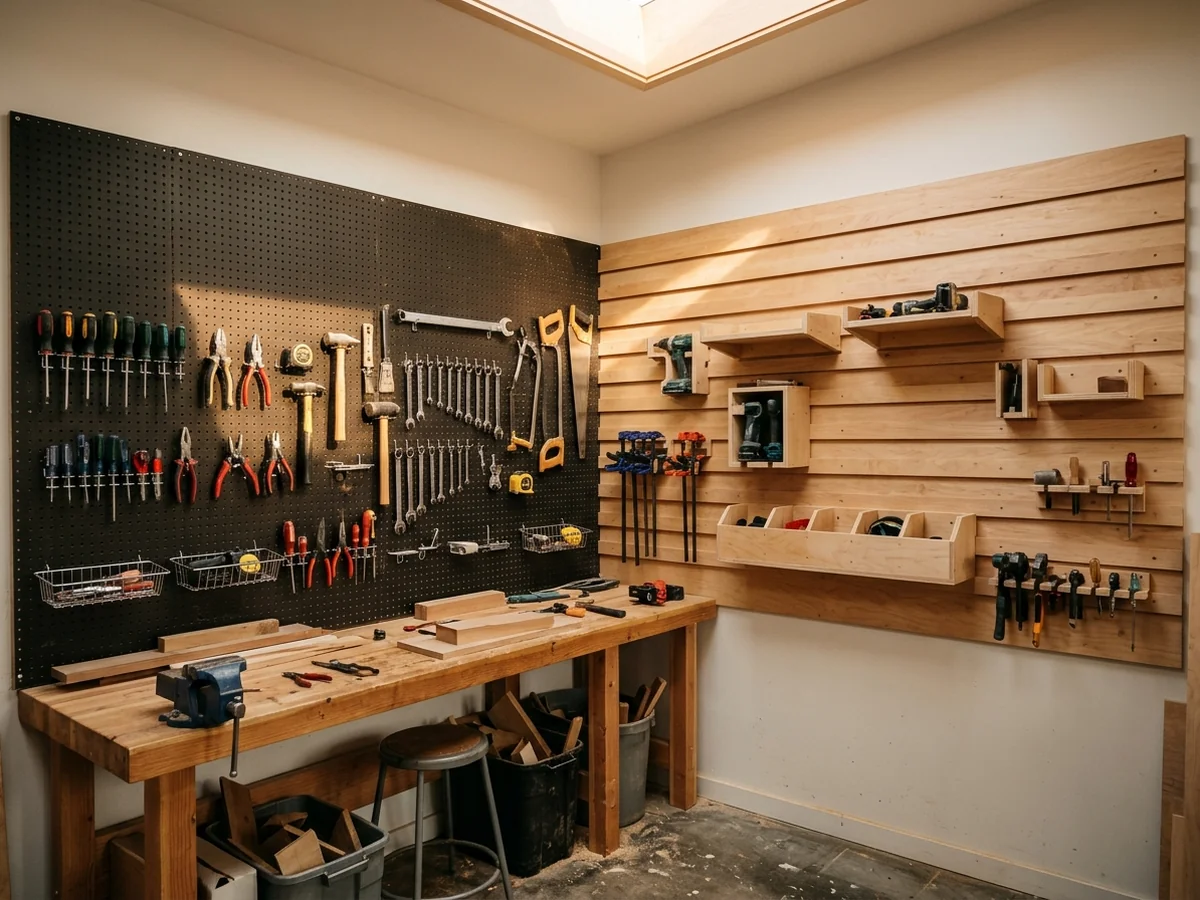
When comparing pegboard vs plywood tool walls for a high‑humidity shed, the key difference lies in how each material handles moisture and supports tools. Pegboard offers easy reconfiguration, while plywood provides a solid surface that can bear heavier items.
Storing tools in a shed that sees regular condensation can cause rust, warping, and unsafe conditions if the wall material isn’t weather‑resistant. This article explains why durability against moisture matters for the longevity of your storage system and for maintaining a safe workspace. You’ll learn the basic pros and cons of each DIY option and what to consider when choosing a wall that will hold up over time.
Moisture Impact on Pegboard vs Plywood
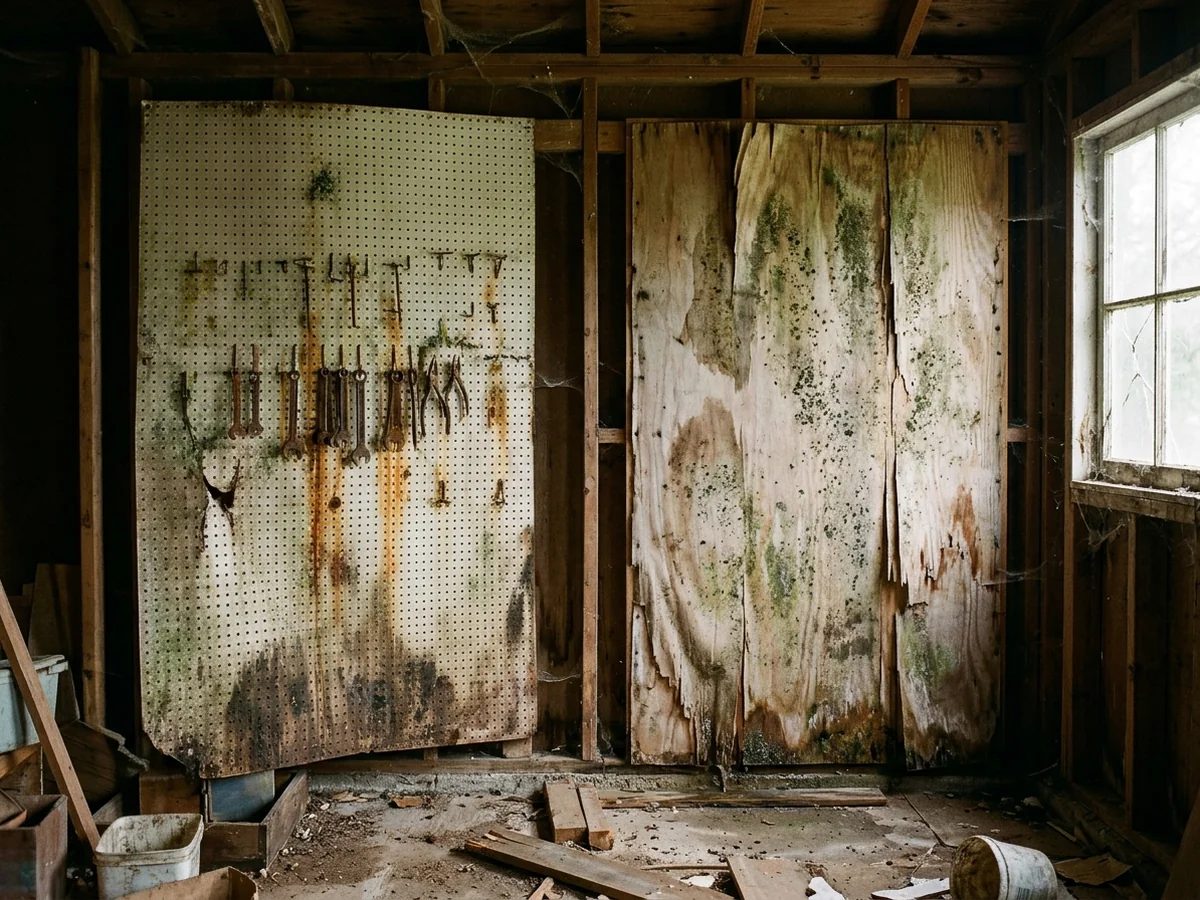
In humid environments, wood panels tend to absorb moisture, causing them to swell, while metal hooks can rust and mold may develop on untreated surfaces. These reactions compromise both strength and appearance.
Untreated plywood is especially vulnerable because its porous layers allow water to penetrate quickly, leading to expansion that can warp the board and loosen fasteners. Once the wood fibers swell, any attached hardware may shift, reducing the wall’s load‑bearing capacity.
Coated pegboard offers a degree of natural resistance. Factory‑applied powder‑coat or a polymer seal creates a barrier that slows water absorption, so the board stays flatter and metal hooks remain less prone to corrosion. However, the protection is only as good as the coating’s integrity; chips or scratches expose the underlying material to the same risks as raw wood.
Applying a finish is essential for both materials. For plywood, a combination of paint and a waterproof sealant creates a sealed surface that limits swelling and blocks mold spores. For pegboard, powder‑coating provides a hard, weather‑resistant skin, while a clear sealant can be used on painted surfaces to add extra protection.
- Paint + sealant on plywood , creates a moisture‑tight barrier.
- Powder‑coat on pegboard , offers durable, rust‑resistant protection.
- Clear sealant over painted pegboard , adds a secondary shield against humidity.
Pegboard vs Plywood Design Differences
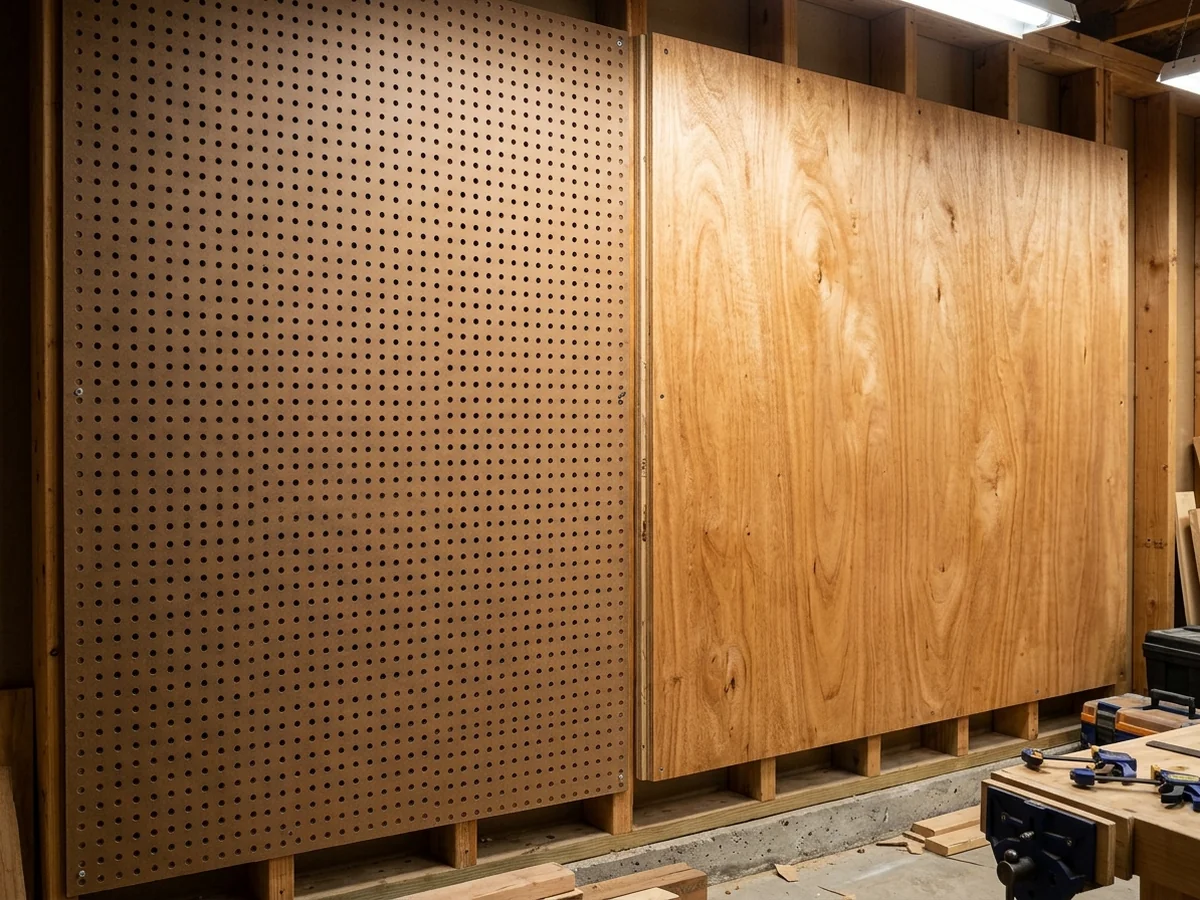
Typical pegboard dimensions and hole spacing
Pegboard panels are most often sold in 4‑foot by 8‑foot sheets with a standard 1‑inch grid of round holes. Each hole is spaced one inch apart both horizontally and vertically, creating a uniform matrix for hooks and accessories. Common alternative sizes include 2‑foot by 4‑foot panels, which are easier to handle in tight shed spaces.
Mounting methods for shed walls
Both systems rely on studs or sturdy anchors, but the approach differs. Pegboard typically attaches to wall studs with screws that pass through the panel’s back and into the framing, or it can be hung from heavy‑duty drywall anchors when studs are unavailable. Plywood sheets are fastened directly to studs using wood screws or to the shed’s framing with metal brackets. For high‑humidity sheds, a waterproof backing such as a vinyl moisture barrier or sealed plywood sheathing helps protect the wall and prolongs the life of either material.
General weight limits and factors that influence capacity
How much a wall can hold depends on panel thickness, the backing material, and the type of hooks or brackets used. Thicker pegboard (often ¼‑inch) offers a higher pegboard weight capacity than thinner variants, especially when paired with sturdy metal hooks. Plywood’s load‑bearing ability is tied to its thickness and the spacing of fasteners; a ¾‑inch sheet anchored to studs can support heavier tools than a thinner board. In both cases, using corrosion‑resistant hardware and ensuring the backing is moisture‑resistant improve overall strength.
Key considerations for choosing between the two include:
- Standard pegboard provides a flexible grid that adapts to many small tools, while plywood offers a solid surface for larger items.
- Installation of pegboard is straightforward with a 1‑inch hole pattern, but plywood may require additional framing to prevent sagging.
- Moisture‑resistant backing is essential in humid sheds to avoid warping of either material.
- Weight capacity rises with thicker panels, secure stud attachment, and the use of robust hooks or brackets.
- Both options benefit from stainless‑steel or coated fasteners to resist rust in damp environments.
SEO Content Researcher and Writer.
“Weather-Resistant Pegboard vs Plywood Tool Walls for High-Humidity Sheds”.
“pegboard vs plywood tool walls”.
`
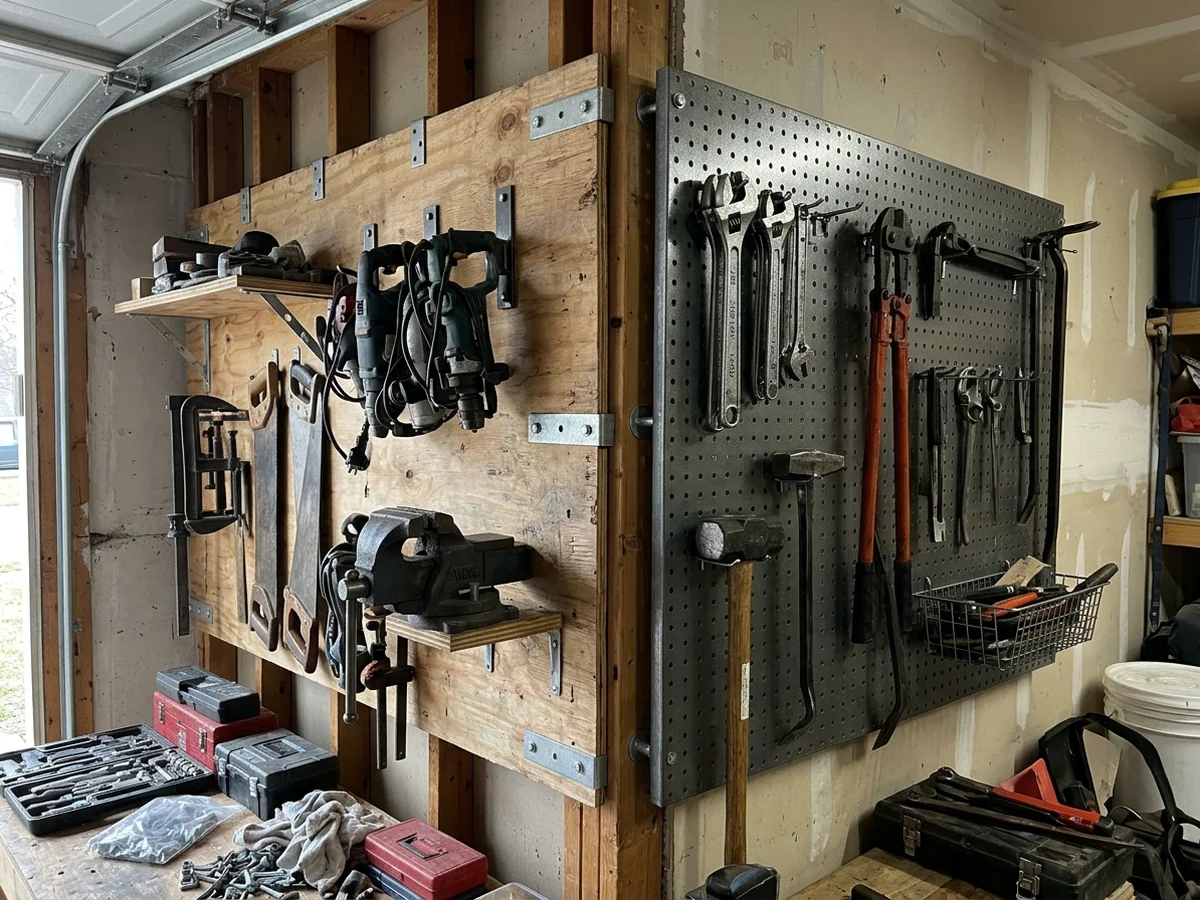
Plywood vs Pegboard Strength Comparison
`.
Contrast soft-core, hardwood, and marine-grade plywood; show how to add slats, hooks, or magnetic strips; detail steps for applying waterproof sealants and paint.
* Length: ~366 words (Hard limit: 457).
* Structure: `
`, then `
` subheadings.
* `
` 1: Choosing the right grade and thickness.
* `
` 2: Fastening systems for high‑load tools.
* `
` 3: Sealing and painting for humidity protection.
* One `
` or `
` of 4-7 `
- ` items (full sentences) with a short `
` before it.
* No em dashes (, ) or en dashes (, ).
* No rhetorical questions, excessive exclamation marks, generic AI intros, or repetitive conclusions.
* No keyword stuffing.
* No fake stats, invented sources, or personal experience.
* Answer first (opening 1-2 sentences).
* One idea per paragraph, paragraphs under 90 words.
* HTML output only.
* Fact Sheet: Empty (no verified claims).
* Research Data: General info provided, but no specific numbers/stats verified.
* Guidance: Use plain general terms instead of specific numbers since nothing is marked VERIFIED or CONSENSUS.
* *Section Heading:* `
Plywood vs Pegboard Strength Comparison
Plywood generally provides superior structural strength and weight capacity compared to pegboard. It handles heavier tools and resists warping better in humid environments when the appropriate grade and thickness are selected.
Choosing the right grade and thickness
Plywood varies by core material and glue. Soft‑core options are budget‑friendly but less stable. Hardwood plywood is denser and handles weight better. For sheds with high humidity, marine‑grade plywood is the most resilient choice because it is designed to resist moisture and rot.
Fastening systems for high‑load tools
Because plywood lacks pre‑drilled holes, additional hardware is needed. Common methods include:
- Screw wooden slats to create custom hook rows.
- Install metal rails for modular storage.
- Attach magnetic strips for small metal items.
- Use heavy‑duty screws for large power tools.
- Mount specialized brackets for long‑handled equipment.
These options make a plywood wall a strong alternative in the pegboard vs plywood tool walls discussion.
Sealing and painting for humidity protection
Apply a waterproof sealant and paint to prevent moisture absorption. Typical steps are sanding, priming, sealing, and painting, which together help avoid rot and extend the wall’s lifespan.
Side‑by‑Side Comparison: Pegboard vs Plywood in a Humid Shed

Side‑by‑Side Comparison: Pegboard vs Plywood in a Humid Shed `.
* Durability against moisture.
* Maximum safe load per square foot.
* Ease of reconfiguration.
* Cost of materials and installation.
* Aesthetic compatibility with home-decor style.
* Answer first (1-2 sentences).
* One idea per section.
* HTML output only (`
`, `
`, `
`, etc.).
* No preamble, no commentary.
* Professional, informative, plain language.
* No em dashes (, ) or en dashes (, ).
* No rhetorical questions, exclamation marks, or AI filler.
* Length: ~366 words (Hard limit 457).
* No keyword stuffing.
* No invented facts/numbers (Fact sheet is empty, so use general terms).
* One HTML table with `
` and `
`.
* One short `
` before the table, one short `
` after.
* Paragraphs under 90 words.
* No “pegboard vs plywood tool walls” exact phrase in this section (use variations).
* *Fact Sheet:* Empty. (Constraint: No specific numbers/stats. Use general terms).
* *Research Data:* General info about pegboard and plywood.
* *Brand Rules:* Site is `denaesthetic.com`. Do not say it sells these items.
* *Opening:* Plywood generally offers superior moisture resistance and weight capacity, while pegboard provides better flexibility for changing tool layouts.
* *Table Content:*
* Moisture Durability: Plywood (Higher/better with sealant) vs Pegboard (Variable/lower).
* Weight Capacity: Plywood (High) vs Pegboard (Moderate).
* Reconfiguration: Plywood (Low/requires drilling) vs Pegboard (High/hooks).
* Cost: Plywood (Moderate) vs Pegboard (Low to Moderate).
* Aesthetics: Plywood (Rustic/Clean) vs Pegboard (Industrial).
* *Paragraph 1 (Answer):* Plywood is typically more durable and holds more weight in damp conditions, but pegboard is much easier to reorganize. Choosing between them depends on whether you prioritize strength or flexibility.
* *Paragraph 2 (Pre-table):* These two options differ significantly in how they handle humidity and tool weight. The following table highlights the primary trade offs.
* *Table:* (HTML construction).
* *Paragraph 3 (Post-table):* Plywood requires more effort to install and change, as it usually involves screws or custom brackets. Pegboard uses a hook system that lets you move tools in seconds.
* *Paragraph 4 (Moisture/Cost/Aesthetics):* In high humidity, treated plywood resists warping better than standard fiberboard pegboards. While plywood fits a rustic or clean look, pegboard has a more functional, industrial feel. Costs vary by material grade, but both are generally affordable for home shed projects.
* *Em dashes/En dashes?* None.
* *Exclamation marks?* None.
* *AI phrases?* Checked.
* *Keyword?* Used “tool wall comparison” or “comparing these storage options”. Avoided exact phrase “pegboard vs plywood tool walls”.
* *Paragraph lengths?* All under 90 words.
* *HTML tags?* Only `
`, `
`, `
`, `
`, `
`, `
`, `
`, `
`.
* *Fact check:* No invented numbers. Used terms like “high”, “moderate”, “variable”.
* *Opening:* Plywood usually provides better moisture resistance and weight support, while pegboard offers superior flexibility for rearranging tools. The best choice depends on whether you need heavy duty strength or a customizable layout.
* *Pre-table:* These storage systems handle humidity and load differently. This tool wall comparison breaks down the main differences.
Pegboard vs Plywood Choice
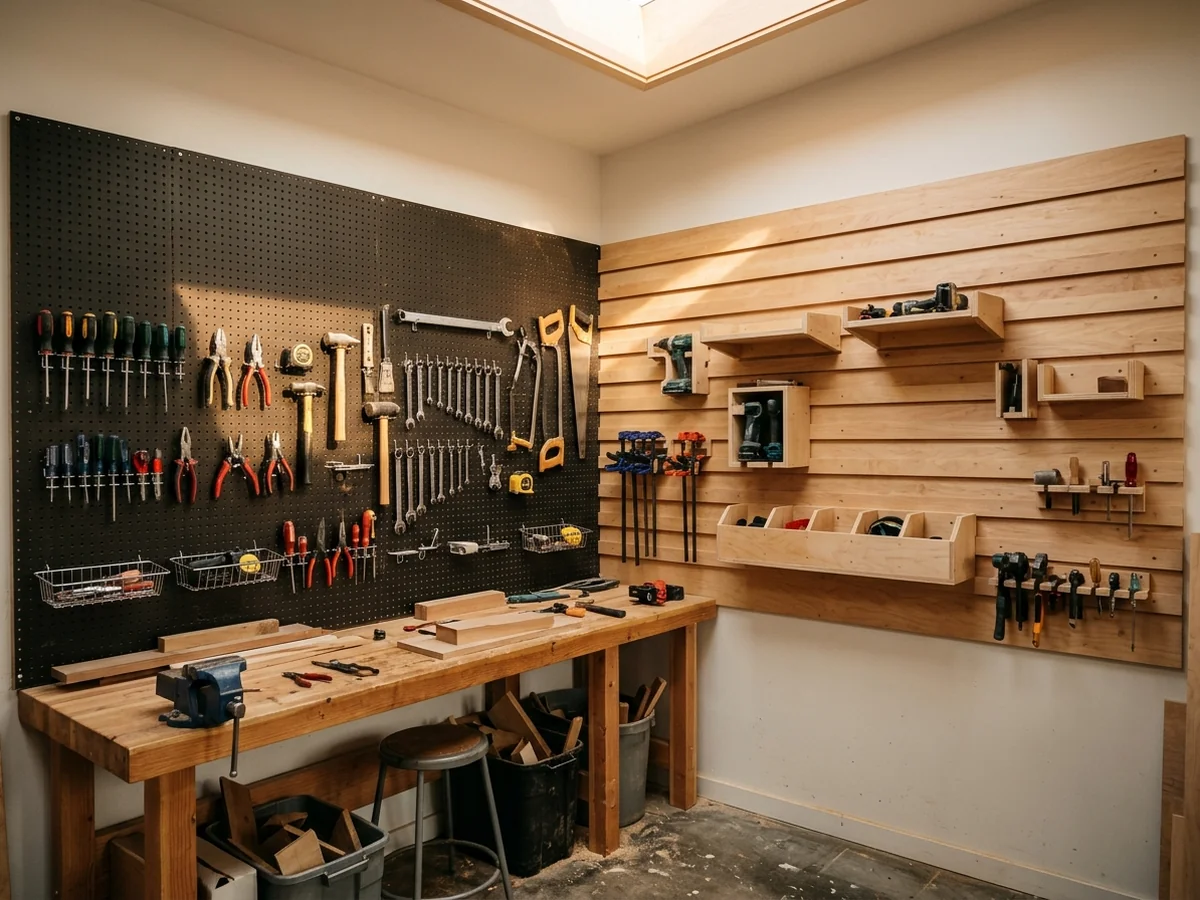
Pegboard vs Plywood Choice Slat walls are vertical panels fitted with evenly spaced wooden slats that accept hooks or brackets, while pegboards are perforated boards that hold pegs inserted into a grid of holes. The two systems differ in mounting method, load distribution, and visual style.
Slat walls excel when you need to hang heavy tools such as ladders, large power tools, or bundled cords. The solid wood slats spread weight across the wall, reducing stress on any single point and creating a cleaner, more uniform look that can match a workshop’s aesthetic.
- Heavy or irregularly shaped items benefit from the continuous support of slats.
- When a seamless, built‑in appearance is desired, slats provide a sleek, uninterrupted surface.
- Projects that involve frequent rearrangement of large pieces still retain strength because the slats stay fixed.
In contrast, a pegboard remains the most flexible option for organizing a wide variety of small to medium tools. The grid of holes lets you place pegs exactly where needed, allowing rapid reconfiguration as your collection changes. Because each peg bears its own load, the system adapts well to light‑weight items and decorative accessories without requiring a full‑length support structure.
Pegboard vs Plywood Alternatives

Pegboard vs Plywood Alternatives Metal slat systems with powder‑coat finish
Metal slat walls resist moisture better than untreated wood, making them a solid choice for damp sheds. They are typically sold at home‑improvement centers and online retailers, with prices ranging from moderate to premium depending on gauge and finish.
- Pros include high durability, easy cleaning, and the ability to hold heavier tools without warping.
- Cons are the higher upfront cost and the need for compatible hooks or brackets.
- These panels attach to studs using self‑tapping screws, fitting neatly into existing framing.
- Because they do not swell, they stay level even when the shed humidity spikes.
PVC or composite panels
PVC and composite boards are lightweight, water‑proof options that can be sourced from building‑supply outlets or specialty plastic distributors, generally priced in the low‑to‑mid range.
- Advantages are resistance to rot, no splintering, and simple installation with adhesive or mechanical fasteners.
- Drawbacks include lower load capacity compared with metal or solid wood.
- Panels can be cut to size and mounted directly over existing sheathing, integrating without major structural changes.
- The smooth surface also allows optional peg or magnetic accessories to be added.
Modular magnetic boards
Magnetic tool boards combine a steel backing with a decorative surface and are available from specialty organizers or online marketplaces, often costing a bit more than basic pegboard.
- They excel in humid conditions because the steel core does not absorb moisture.
- Limitations are the need for magnetic fasteners, which may not suit every tool shape.
- Installation involves screwing the backing into studs, after which magnetic strips or containers can be arranged freely.
- The modular design lets you expand or reconfigure the layout as storage needs evolve.
Installing Pegboard vs Plywood

Installing Pegboard vs Plywood When planning a tool storage area, choosing between a dedicated pegboard and a plywood backer involves understanding how these materials interact with your space. While drywall is a standard finish for interior rooms, it often struggles in non‑climate‑controlled environments like sheds or garages. Drywall tends to absorb ambient humidity, which can lead to swelling, crumbling of the gypsum core, and eventual failure of the joint compound. If your goal is a long‑term storage solution, relying on bare drywall to support heavy tools is rarely effective.
Plywood serves as an excellent foundation because it offers superior structural rigidity. It provides a dense, stable surface that can hold screws firmly, making it a reliable base for heavy items. By installing a plywood layer first, you create a moisture‑resistant barrier that shields the wall structure and provides a uniform surface for attaching secondary organizers like pegboard. This approach essentially gives you the organizational versatility of a peg system combined with the load‑bearing strength of a solid wooden wall.
To ensure a professional and durable installation, follow these practical steps:
- Begin by measuring your wall space and cutting high‑quality plywood to size. It is helpful to leave a small gap between the bottom of the wood and the floor to prevent moisture wicking.
- Secure the plywood directly to the wall studs using corrosion‑resistant screws. Proper spacing is essential for stability, so ensure your fasteners are distributed evenly across the frame.
- Once the plywood base is secure, you can mount the pegboard. Applying a construction‑grade adhesive to the back of the board before fastening helps eliminate hollow sounds and provides extra support.
- When driving screws through the pegboard, use washers to distribute the weight. This prevents the screw heads from pulling through the board material under the load of heavy tools.
- Finally, seal the edges of the plywood and any exposed screw heads with a moisture‑resistant finish. This small step significantly extends the life of your installation by preventing condensation from reaching the wood fibers.
A common mistake is attaching pegboard directly to studs without a backer. Without the plywood, the board may flex under weight, causing hooks to loosen or the board to crack. By treating the plywood as the primary structural layer, you create a wall that remains functional and aesthetically pleasing for years, regardless of the humidity fluctuations typical in outdoor workspaces.
Maintaining Pegboard vs Plywood Walls

Maintaining Pegboard vs Plywood Walls Regular upkeep keeps both perforated panels and wooden slat walls functional in damp sheds, preventing rust, warping, and loose fittings from compromising safety.
Follow a simple routine that addresses inspection, protective coatings, and tool storage to extend the life of any high‑humidity wall system.
- Inspect the surface and hardware at least once a month, looking for any signs of corrosion on metal hooks or swelling in the wood.
- Check each fastener for tightness; replace stripped screws or loose anchors before the weight load shifts.
- Apply a fresh coat of rust‑inhibiting primer to metal pegboard and a water‑resistant paint or sealant to plywood every 12‑18 months, or sooner if you notice chalking or moisture penetration.
- When resealing, sand lightly to promote adhesion, then use a breathable, mildew‑resistant finish that allows the wood to expand without trapping moisture.
- Store tools that are still wet or damp on a separate rack or in a waterproof container rather than hanging them directly on the wall, which reduces the risk of rust spreading to hooks.
- Allow wet items to air dry in a well‑ventilated area before returning them to the wall, and wipe down any condensation that collects on the surface after use.
FAQ
Is peg board or slat wall better?
Slat wall systems usually offer higher weight capacities and a more finished look, whereas pegboard provides a budget-friendly option with greater flexibility for rearranging hooks. Choosing between them depends on how heavy your tools are and how often you plan to change your layout. Each material handles moisture and shed environments differently depending on its coating and core composition.
How much weight can a pegboard wall hold?
The total weight a pegboard can support depends heavily on the panel material, thickness, and how securely it is fastened to the wall studs. Metal panels typically hold significantly more weight than standard fiberboard, which can sag or tear under heavy loads in damp conditions. Using proper mounting spacers and distributing heavy tools across multiple anchor points will maximize overall capacity.
Is there something better than pegboard?
Solid wood panels, metal grid systems, and French cleats often serve as superior alternatives for high-humidity sheds where standard fiberboard would warp or degrade. Plywood tool walls provide exceptional strength and customisation potential without the structural limitations of traditional hole-pattern panels. Selecting the right alternative comes down to your local climate and the specific weight of your gear.
Can you use pegboard instead of drywall?
You can install pegboard as a primary wall surface in utility spaces like sheds, but it lacks the thermal insulation and fire-rated properties of standard drywall. Plywood tool walls or specialized panels often provide a more durable and rigid finished surface for supporting heavy workshop equipment. Local building codes may dictate what materials are permitted for interior walls depending on the specific classification of your outbuilding.
Conclusion
Choosing between these two systems depends on balancing your shed’s specific climate conditions against the weight of your tools. While pegboard offers unmatched modularity for lighter items, plywood provides a robust, load‑bearing surface better suited for heavier gear in humid environments. Consider how often you need to rearrange your space and the long‑term moisture levels of your storage area before committing to your setup. Evaluating a pegboard compared with plywood for a tool wall requires weighing the convenience of quick adjustments against the structural reliability of a solid wood backing. Once you match the material to your local climate and your specific storage needs, you can build a durable wall that keeps your equipment organized for years.
You might also like: T-Hinges vs Strap Hinges: What Size Screws Fasten Shed Doors to Studs?
Similar Posts
10 diy coffee tables you need for every budget
Discover 10 DIY coffee tables for every budget, from beginner to advanced. Learn tools, ripping, pocket holes, sanding, and finishing tips to create a…
10 Blue Gray Kitchen Cabinets That Feel Fresh and Modern
White kitchens are lovely, but I’ve lost count of how many homeowners tell me theirs feels a little flat. Black feels heavy, wood can feel dated, and bold colors seem risky when you’ll be looking at them every single morning. That’s usually the moment a softer, smarter choice enters the conversation. Blue gray sits right…
how to make a small bedroom look like a luxury suite on a budget
Learn how to transform a compact sleeping area into an upscale small bedroom luxury suite on a budget with clever design, lighting, and decor tips.
10 Backyard Landscape Design Ideas That Feel Like a Resort
A backyard doesn’t need an enormous budget or a sprawling property to feel like a private resort. Often, the difference comes down to how thoughtfully the space is planned. When comfortable seating, layered greenery, warm lighting, natural materials, and a few intentional focal points work together, even an ordinary yard can become a place where…
How to Decorate a Bedroom with Designer Color Palettes
A beautiful bedroom rarely comes down to one perfect paint color. What makes a room feel polished is the way several colors work together—on the walls, bedding, furniture, window treatments, rugs, and smaller decorative accents. A thoughtful palette can make a bedroom feel warmer, brighter, calmer, richer, or even more sophisticated without requiring a complete…
* `
` 1: Choosing the right grade and thickness.
* `
` 2: Fastening systems for high‑load tools.
* `
` 3: Sealing and painting for humidity protection.
* One `
` or `
` of 4-7 `
- ` items (full sentences) with a short `
` before it.
* No em dashes (, ) or en dashes (, ).
* No rhetorical questions, excessive exclamation marks, generic AI intros, or repetitive conclusions.
* No keyword stuffing.
* No fake stats, invented sources, or personal experience.
* Answer first (opening 1-2 sentences).
* One idea per paragraph, paragraphs under 90 words.
* HTML output only.
* Fact Sheet: Empty (no verified claims).
* Research Data: General info provided, but no specific numbers/stats verified.
* Guidance: Use plain general terms instead of specific numbers since nothing is marked VERIFIED or CONSENSUS.
* *Section Heading:* `
Plywood vs Pegboard Strength Comparison
Plywood generally provides superior structural strength and weight capacity compared to pegboard. It handles heavier tools and resists warping better in humid environments when the appropriate grade and thickness are selected.
Choosing the right grade and thickness
Plywood varies by core material and glue. Soft‑core options are budget‑friendly but less stable. Hardwood plywood is denser and handles weight better. For sheds with high humidity, marine‑grade plywood is the most resilient choice because it is designed to resist moisture and rot.
Fastening systems for high‑load tools
Because plywood lacks pre‑drilled holes, additional hardware is needed. Common methods include:
- Screw wooden slats to create custom hook rows.
- Install metal rails for modular storage.
- Attach magnetic strips for small metal items.
- Use heavy‑duty screws for large power tools.
- Mount specialized brackets for long‑handled equipment.
These options make a plywood wall a strong alternative in the pegboard vs plywood tool walls discussion.
Sealing and painting for humidity protection
Apply a waterproof sealant and paint to prevent moisture absorption. Typical steps are sanding, priming, sealing, and painting, which together help avoid rot and extend the wall’s lifespan.
Side‑by‑Side Comparison: Pegboard vs Plywood in a Humid Shed
Side‑by‑Side Comparison: Pegboard vs Plywood in a Humid Shed `.
* Durability against moisture.
* Maximum safe load per square foot.
* Ease of reconfiguration.
* Cost of materials and installation.
* Aesthetic compatibility with home-decor style.
* Answer first (1-2 sentences).
* One idea per section.
* HTML output only (`
`, `
`, `
`, etc.).
* No preamble, no commentary.
* Professional, informative, plain language.
* No em dashes (, ) or en dashes (, ).
* No rhetorical questions, exclamation marks, or AI filler.
* Length: ~366 words (Hard limit 457).
* No keyword stuffing.
* No invented facts/numbers (Fact sheet is empty, so use general terms).
* One HTML table with `
` and `
`.
* One short `
` before the table, one short `
` after.
* Paragraphs under 90 words.
* No “pegboard vs plywood tool walls” exact phrase in this section (use variations).
* *Fact Sheet:* Empty. (Constraint: No specific numbers/stats. Use general terms).
* *Research Data:* General info about pegboard and plywood.
* *Brand Rules:* Site is `denaesthetic.com`. Do not say it sells these items.
* *Opening:* Plywood generally offers superior moisture resistance and weight capacity, while pegboard provides better flexibility for changing tool layouts.
* *Table Content:*
* Moisture Durability: Plywood (Higher/better with sealant) vs Pegboard (Variable/lower).
* Weight Capacity: Plywood (High) vs Pegboard (Moderate).
* Reconfiguration: Plywood (Low/requires drilling) vs Pegboard (High/hooks).
* Cost: Plywood (Moderate) vs Pegboard (Low to Moderate).
* Aesthetics: Plywood (Rustic/Clean) vs Pegboard (Industrial).
* *Paragraph 1 (Answer):* Plywood is typically more durable and holds more weight in damp conditions, but pegboard is much easier to reorganize. Choosing between them depends on whether you prioritize strength or flexibility.
* *Paragraph 2 (Pre-table):* These two options differ significantly in how they handle humidity and tool weight. The following table highlights the primary trade offs.
* *Table:* (HTML construction).
* *Paragraph 3 (Post-table):* Plywood requires more effort to install and change, as it usually involves screws or custom brackets. Pegboard uses a hook system that lets you move tools in seconds.
* *Paragraph 4 (Moisture/Cost/Aesthetics):* In high humidity, treated plywood resists warping better than standard fiberboard pegboards. While plywood fits a rustic or clean look, pegboard has a more functional, industrial feel. Costs vary by material grade, but both are generally affordable for home shed projects.
* *Em dashes/En dashes?* None.
* *Exclamation marks?* None.
* *AI phrases?* Checked.
* *Keyword?* Used “tool wall comparison” or “comparing these storage options”. Avoided exact phrase “pegboard vs plywood tool walls”.
* *Paragraph lengths?* All under 90 words.
* *HTML tags?* Only `
`, `
`, `
`, `
`, `
`, `
`, `
`, `
`.
* *Fact check:* No invented numbers. Used terms like “high”, “moderate”, “variable”.
* *Opening:* Plywood usually provides better moisture resistance and weight support, while pegboard offers superior flexibility for rearranging tools. The best choice depends on whether you need heavy duty strength or a customizable layout.
* *Pre-table:* These storage systems handle humidity and load differently. This tool wall comparison breaks down the main differences.
Pegboard vs Plywood Choice
Pegboard vs Plywood Choice Slat walls are vertical panels fitted with evenly spaced wooden slats that accept hooks or brackets, while pegboards are perforated boards that hold pegs inserted into a grid of holes. The two systems differ in mounting method, load distribution, and visual style.
Slat walls excel when you need to hang heavy tools such as ladders, large power tools, or bundled cords. The solid wood slats spread weight across the wall, reducing stress on any single point and creating a cleaner, more uniform look that can match a workshop’s aesthetic.
- Heavy or irregularly shaped items benefit from the continuous support of slats.
- When a seamless, built‑in appearance is desired, slats provide a sleek, uninterrupted surface.
- Projects that involve frequent rearrangement of large pieces still retain strength because the slats stay fixed.
In contrast, a pegboard remains the most flexible option for organizing a wide variety of small to medium tools. The grid of holes lets you place pegs exactly where needed, allowing rapid reconfiguration as your collection changes. Because each peg bears its own load, the system adapts well to light‑weight items and decorative accessories without requiring a full‑length support structure.
Pegboard vs Plywood Alternatives
Pegboard vs Plywood Alternatives Metal slat systems with powder‑coat finish
Metal slat walls resist moisture better than untreated wood, making them a solid choice for damp sheds. They are typically sold at home‑improvement centers and online retailers, with prices ranging from moderate to premium depending on gauge and finish.
- Pros include high durability, easy cleaning, and the ability to hold heavier tools without warping.
- Cons are the higher upfront cost and the need for compatible hooks or brackets.
- These panels attach to studs using self‑tapping screws, fitting neatly into existing framing.
- Because they do not swell, they stay level even when the shed humidity spikes.
PVC or composite panels
PVC and composite boards are lightweight, water‑proof options that can be sourced from building‑supply outlets or specialty plastic distributors, generally priced in the low‑to‑mid range.
- Advantages are resistance to rot, no splintering, and simple installation with adhesive or mechanical fasteners.
- Drawbacks include lower load capacity compared with metal or solid wood.
- Panels can be cut to size and mounted directly over existing sheathing, integrating without major structural changes.
- The smooth surface also allows optional peg or magnetic accessories to be added.
Modular magnetic boards
Magnetic tool boards combine a steel backing with a decorative surface and are available from specialty organizers or online marketplaces, often costing a bit more than basic pegboard.
- They excel in humid conditions because the steel core does not absorb moisture.
- Limitations are the need for magnetic fasteners, which may not suit every tool shape.
- Installation involves screwing the backing into studs, after which magnetic strips or containers can be arranged freely.
- The modular design lets you expand or reconfigure the layout as storage needs evolve.
Installing Pegboard vs Plywood
Installing Pegboard vs Plywood When planning a tool storage area, choosing between a dedicated pegboard and a plywood backer involves understanding how these materials interact with your space. While drywall is a standard finish for interior rooms, it often struggles in non‑climate‑controlled environments like sheds or garages. Drywall tends to absorb ambient humidity, which can lead to swelling, crumbling of the gypsum core, and eventual failure of the joint compound. If your goal is a long‑term storage solution, relying on bare drywall to support heavy tools is rarely effective.
Plywood serves as an excellent foundation because it offers superior structural rigidity. It provides a dense, stable surface that can hold screws firmly, making it a reliable base for heavy items. By installing a plywood layer first, you create a moisture‑resistant barrier that shields the wall structure and provides a uniform surface for attaching secondary organizers like pegboard. This approach essentially gives you the organizational versatility of a peg system combined with the load‑bearing strength of a solid wooden wall.
To ensure a professional and durable installation, follow these practical steps:
- Begin by measuring your wall space and cutting high‑quality plywood to size. It is helpful to leave a small gap between the bottom of the wood and the floor to prevent moisture wicking.
- Secure the plywood directly to the wall studs using corrosion‑resistant screws. Proper spacing is essential for stability, so ensure your fasteners are distributed evenly across the frame.
- Once the plywood base is secure, you can mount the pegboard. Applying a construction‑grade adhesive to the back of the board before fastening helps eliminate hollow sounds and provides extra support.
- When driving screws through the pegboard, use washers to distribute the weight. This prevents the screw heads from pulling through the board material under the load of heavy tools.
- Finally, seal the edges of the plywood and any exposed screw heads with a moisture‑resistant finish. This small step significantly extends the life of your installation by preventing condensation from reaching the wood fibers.
A common mistake is attaching pegboard directly to studs without a backer. Without the plywood, the board may flex under weight, causing hooks to loosen or the board to crack. By treating the plywood as the primary structural layer, you create a wall that remains functional and aesthetically pleasing for years, regardless of the humidity fluctuations typical in outdoor workspaces.
Maintaining Pegboard vs Plywood Walls
Maintaining Pegboard vs Plywood Walls Regular upkeep keeps both perforated panels and wooden slat walls functional in damp sheds, preventing rust, warping, and loose fittings from compromising safety.
Follow a simple routine that addresses inspection, protective coatings, and tool storage to extend the life of any high‑humidity wall system.
- Inspect the surface and hardware at least once a month, looking for any signs of corrosion on metal hooks or swelling in the wood.
- Check each fastener for tightness; replace stripped screws or loose anchors before the weight load shifts.
- Apply a fresh coat of rust‑inhibiting primer to metal pegboard and a water‑resistant paint or sealant to plywood every 12‑18 months, or sooner if you notice chalking or moisture penetration.
- When resealing, sand lightly to promote adhesion, then use a breathable, mildew‑resistant finish that allows the wood to expand without trapping moisture.
- Store tools that are still wet or damp on a separate rack or in a waterproof container rather than hanging them directly on the wall, which reduces the risk of rust spreading to hooks.
- Allow wet items to air dry in a well‑ventilated area before returning them to the wall, and wipe down any condensation that collects on the surface after use.
FAQ
Is peg board or slat wall better?
Slat wall systems usually offer higher weight capacities and a more finished look, whereas pegboard provides a budget-friendly option with greater flexibility for rearranging hooks. Choosing between them depends on how heavy your tools are and how often you plan to change your layout. Each material handles moisture and shed environments differently depending on its coating and core composition.
How much weight can a pegboard wall hold?
The total weight a pegboard can support depends heavily on the panel material, thickness, and how securely it is fastened to the wall studs. Metal panels typically hold significantly more weight than standard fiberboard, which can sag or tear under heavy loads in damp conditions. Using proper mounting spacers and distributing heavy tools across multiple anchor points will maximize overall capacity.
Is there something better than pegboard?
Solid wood panels, metal grid systems, and French cleats often serve as superior alternatives for high-humidity sheds where standard fiberboard would warp or degrade. Plywood tool walls provide exceptional strength and customisation potential without the structural limitations of traditional hole-pattern panels. Selecting the right alternative comes down to your local climate and the specific weight of your gear.
Can you use pegboard instead of drywall?
You can install pegboard as a primary wall surface in utility spaces like sheds, but it lacks the thermal insulation and fire-rated properties of standard drywall. Plywood tool walls or specialized panels often provide a more durable and rigid finished surface for supporting heavy workshop equipment. Local building codes may dictate what materials are permitted for interior walls depending on the specific classification of your outbuilding.
Conclusion
Choosing between these two systems depends on balancing your shed’s specific climate conditions against the weight of your tools. While pegboard offers unmatched modularity for lighter items, plywood provides a robust, load‑bearing surface better suited for heavier gear in humid environments. Consider how often you need to rearrange your space and the long‑term moisture levels of your storage area before committing to your setup. Evaluating a pegboard compared with plywood for a tool wall requires weighing the convenience of quick adjustments against the structural reliability of a solid wood backing. Once you match the material to your local climate and your specific storage needs, you can build a durable wall that keeps your equipment organized for years.
You might also like: T-Hinges vs Strap Hinges: What Size Screws Fasten Shed Doors to Studs?
Similar Posts
10 diy coffee tables you need for every budget
Discover 10 DIY coffee tables for every budget, from beginner to advanced. Learn tools, ripping, pocket holes, sanding, and finishing tips to create a…
10 Blue Gray Kitchen Cabinets That Feel Fresh and Modern
White kitchens are lovely, but I’ve lost count of how many homeowners tell me theirs feels a little flat. Black feels heavy, wood can feel dated, and bold colors seem risky when you’ll be looking at them every single morning. That’s usually the moment a softer, smarter choice enters the conversation. Blue gray sits right…
how to make a small bedroom look like a luxury suite on a budget
Learn how to transform a compact sleeping area into an upscale small bedroom luxury suite on a budget with clever design, lighting, and decor tips.
10 Backyard Landscape Design Ideas That Feel Like a Resort
A backyard doesn’t need an enormous budget or a sprawling property to feel like a private resort. Often, the difference comes down to how thoughtfully the space is planned. When comfortable seating, layered greenery, warm lighting, natural materials, and a few intentional focal points work together, even an ordinary yard can become a place where…
How to Decorate a Bedroom with Designer Color Palettes
A beautiful bedroom rarely comes down to one perfect paint color. What makes a room feel polished is the way several colors work together—on the walls, bedding, furniture, window treatments, rugs, and smaller decorative accents. A thoughtful palette can make a bedroom feel warmer, brighter, calmer, richer, or even more sophisticated without requiring a complete…
* `
` 3: Sealing and painting for humidity protection.
* One `
` or `
` of 4-7 `
- ` items (full sentences) with a short `
` before it.
* No em dashes (, ) or en dashes (, ).
* No rhetorical questions, excessive exclamation marks, generic AI intros, or repetitive conclusions.
* No keyword stuffing.
* No fake stats, invented sources, or personal experience.
* Answer first (opening 1-2 sentences).
* One idea per paragraph, paragraphs under 90 words.
* HTML output only.
* Fact Sheet: Empty (no verified claims).
* Research Data: General info provided, but no specific numbers/stats verified.
* Guidance: Use plain general terms instead of specific numbers since nothing is marked VERIFIED or CONSENSUS.
* *Section Heading:* `
Plywood vs Pegboard Strength Comparison
Plywood generally provides superior structural strength and weight capacity compared to pegboard. It handles heavier tools and resists warping better in humid environments when the appropriate grade and thickness are selected.
Choosing the right grade and thickness
Plywood varies by core material and glue. Soft‑core options are budget‑friendly but less stable. Hardwood plywood is denser and handles weight better. For sheds with high humidity, marine‑grade plywood is the most resilient choice because it is designed to resist moisture and rot.
Fastening systems for high‑load tools
Because plywood lacks pre‑drilled holes, additional hardware is needed. Common methods include:
- Screw wooden slats to create custom hook rows.
- Install metal rails for modular storage.
- Attach magnetic strips for small metal items.
- Use heavy‑duty screws for large power tools.
- Mount specialized brackets for long‑handled equipment.
These options make a plywood wall a strong alternative in the pegboard vs plywood tool walls discussion.
Sealing and painting for humidity protection
Apply a waterproof sealant and paint to prevent moisture absorption. Typical steps are sanding, priming, sealing, and painting, which together help avoid rot and extend the wall’s lifespan.
Side‑by‑Side Comparison: Pegboard vs Plywood in a Humid Shed
Side‑by‑Side Comparison: Pegboard vs Plywood in a Humid Shed `.
* Durability against moisture.
* Maximum safe load per square foot.
* Ease of reconfiguration.
* Cost of materials and installation.
* Aesthetic compatibility with home-decor style.
* Answer first (1-2 sentences).
* One idea per section.
* HTML output only (`
`, `
`, `
`, etc.).
* No preamble, no commentary.
* Professional, informative, plain language.
* No em dashes (, ) or en dashes (, ).
* No rhetorical questions, exclamation marks, or AI filler.
* Length: ~366 words (Hard limit 457).
* No keyword stuffing.
* No invented facts/numbers (Fact sheet is empty, so use general terms).
* One HTML table with `
` and `
`.
* One short `
` before the table, one short `
` after.
* Paragraphs under 90 words.
* No “pegboard vs plywood tool walls” exact phrase in this section (use variations).
* *Fact Sheet:* Empty. (Constraint: No specific numbers/stats. Use general terms).
* *Research Data:* General info about pegboard and plywood.
* *Brand Rules:* Site is `denaesthetic.com`. Do not say it sells these items.
* *Opening:* Plywood generally offers superior moisture resistance and weight capacity, while pegboard provides better flexibility for changing tool layouts.
* *Table Content:*
* Moisture Durability: Plywood (Higher/better with sealant) vs Pegboard (Variable/lower).
* Weight Capacity: Plywood (High) vs Pegboard (Moderate).
* Reconfiguration: Plywood (Low/requires drilling) vs Pegboard (High/hooks).
* Cost: Plywood (Moderate) vs Pegboard (Low to Moderate).
* Aesthetics: Plywood (Rustic/Clean) vs Pegboard (Industrial).
* *Paragraph 1 (Answer):* Plywood is typically more durable and holds more weight in damp conditions, but pegboard is much easier to reorganize. Choosing between them depends on whether you prioritize strength or flexibility.
* *Paragraph 2 (Pre-table):* These two options differ significantly in how they handle humidity and tool weight. The following table highlights the primary trade offs.
* *Table:* (HTML construction).
* *Paragraph 3 (Post-table):* Plywood requires more effort to install and change, as it usually involves screws or custom brackets. Pegboard uses a hook system that lets you move tools in seconds.
* *Paragraph 4 (Moisture/Cost/Aesthetics):* In high humidity, treated plywood resists warping better than standard fiberboard pegboards. While plywood fits a rustic or clean look, pegboard has a more functional, industrial feel. Costs vary by material grade, but both are generally affordable for home shed projects.
* *Em dashes/En dashes?* None.
* *Exclamation marks?* None.
* *AI phrases?* Checked.
* *Keyword?* Used “tool wall comparison” or “comparing these storage options”. Avoided exact phrase “pegboard vs plywood tool walls”.
* *Paragraph lengths?* All under 90 words.
* *HTML tags?* Only `
`, `
`, `
`, `
`, `
`, `
`, `
`, `
`.
* *Fact check:* No invented numbers. Used terms like “high”, “moderate”, “variable”.
* *Opening:* Plywood usually provides better moisture resistance and weight support, while pegboard offers superior flexibility for rearranging tools. The best choice depends on whether you need heavy duty strength or a customizable layout.
* *Pre-table:* These storage systems handle humidity and load differently. This tool wall comparison breaks down the main differences.
Pegboard vs Plywood Choice
Pegboard vs Plywood Choice Slat walls are vertical panels fitted with evenly spaced wooden slats that accept hooks or brackets, while pegboards are perforated boards that hold pegs inserted into a grid of holes. The two systems differ in mounting method, load distribution, and visual style.
Slat walls excel when you need to hang heavy tools such as ladders, large power tools, or bundled cords. The solid wood slats spread weight across the wall, reducing stress on any single point and creating a cleaner, more uniform look that can match a workshop’s aesthetic.
- Heavy or irregularly shaped items benefit from the continuous support of slats.
- When a seamless, built‑in appearance is desired, slats provide a sleek, uninterrupted surface.
- Projects that involve frequent rearrangement of large pieces still retain strength because the slats stay fixed.
In contrast, a pegboard remains the most flexible option for organizing a wide variety of small to medium tools. The grid of holes lets you place pegs exactly where needed, allowing rapid reconfiguration as your collection changes. Because each peg bears its own load, the system adapts well to light‑weight items and decorative accessories without requiring a full‑length support structure.
Pegboard vs Plywood Alternatives
Pegboard vs Plywood Alternatives Metal slat systems with powder‑coat finish
Metal slat walls resist moisture better than untreated wood, making them a solid choice for damp sheds. They are typically sold at home‑improvement centers and online retailers, with prices ranging from moderate to premium depending on gauge and finish.
- Pros include high durability, easy cleaning, and the ability to hold heavier tools without warping.
- Cons are the higher upfront cost and the need for compatible hooks or brackets.
- These panels attach to studs using self‑tapping screws, fitting neatly into existing framing.
- Because they do not swell, they stay level even when the shed humidity spikes.
PVC or composite panels
PVC and composite boards are lightweight, water‑proof options that can be sourced from building‑supply outlets or specialty plastic distributors, generally priced in the low‑to‑mid range.
- Advantages are resistance to rot, no splintering, and simple installation with adhesive or mechanical fasteners.
- Drawbacks include lower load capacity compared with metal or solid wood.
- Panels can be cut to size and mounted directly over existing sheathing, integrating without major structural changes.
- The smooth surface also allows optional peg or magnetic accessories to be added.
Modular magnetic boards
Magnetic tool boards combine a steel backing with a decorative surface and are available from specialty organizers or online marketplaces, often costing a bit more than basic pegboard.
- They excel in humid conditions because the steel core does not absorb moisture.
- Limitations are the need for magnetic fasteners, which may not suit every tool shape.
- Installation involves screwing the backing into studs, after which magnetic strips or containers can be arranged freely.
- The modular design lets you expand or reconfigure the layout as storage needs evolve.
Installing Pegboard vs Plywood
Installing Pegboard vs Plywood When planning a tool storage area, choosing between a dedicated pegboard and a plywood backer involves understanding how these materials interact with your space. While drywall is a standard finish for interior rooms, it often struggles in non‑climate‑controlled environments like sheds or garages. Drywall tends to absorb ambient humidity, which can lead to swelling, crumbling of the gypsum core, and eventual failure of the joint compound. If your goal is a long‑term storage solution, relying on bare drywall to support heavy tools is rarely effective.
Plywood serves as an excellent foundation because it offers superior structural rigidity. It provides a dense, stable surface that can hold screws firmly, making it a reliable base for heavy items. By installing a plywood layer first, you create a moisture‑resistant barrier that shields the wall structure and provides a uniform surface for attaching secondary organizers like pegboard. This approach essentially gives you the organizational versatility of a peg system combined with the load‑bearing strength of a solid wooden wall.
To ensure a professional and durable installation, follow these practical steps:
- Begin by measuring your wall space and cutting high‑quality plywood to size. It is helpful to leave a small gap between the bottom of the wood and the floor to prevent moisture wicking.
- Secure the plywood directly to the wall studs using corrosion‑resistant screws. Proper spacing is essential for stability, so ensure your fasteners are distributed evenly across the frame.
- Once the plywood base is secure, you can mount the pegboard. Applying a construction‑grade adhesive to the back of the board before fastening helps eliminate hollow sounds and provides extra support.
- When driving screws through the pegboard, use washers to distribute the weight. This prevents the screw heads from pulling through the board material under the load of heavy tools.
- Finally, seal the edges of the plywood and any exposed screw heads with a moisture‑resistant finish. This small step significantly extends the life of your installation by preventing condensation from reaching the wood fibers.
A common mistake is attaching pegboard directly to studs without a backer. Without the plywood, the board may flex under weight, causing hooks to loosen or the board to crack. By treating the plywood as the primary structural layer, you create a wall that remains functional and aesthetically pleasing for years, regardless of the humidity fluctuations typical in outdoor workspaces.
Maintaining Pegboard vs Plywood Walls
Maintaining Pegboard vs Plywood Walls Regular upkeep keeps both perforated panels and wooden slat walls functional in damp sheds, preventing rust, warping, and loose fittings from compromising safety.
Follow a simple routine that addresses inspection, protective coatings, and tool storage to extend the life of any high‑humidity wall system.
- Inspect the surface and hardware at least once a month, looking for any signs of corrosion on metal hooks or swelling in the wood.
- Check each fastener for tightness; replace stripped screws or loose anchors before the weight load shifts.
- Apply a fresh coat of rust‑inhibiting primer to metal pegboard and a water‑resistant paint or sealant to plywood every 12‑18 months, or sooner if you notice chalking or moisture penetration.
- When resealing, sand lightly to promote adhesion, then use a breathable, mildew‑resistant finish that allows the wood to expand without trapping moisture.
- Store tools that are still wet or damp on a separate rack or in a waterproof container rather than hanging them directly on the wall, which reduces the risk of rust spreading to hooks.
- Allow wet items to air dry in a well‑ventilated area before returning them to the wall, and wipe down any condensation that collects on the surface after use.
FAQ
Is peg board or slat wall better?
Slat wall systems usually offer higher weight capacities and a more finished look, whereas pegboard provides a budget-friendly option with greater flexibility for rearranging hooks. Choosing between them depends on how heavy your tools are and how often you plan to change your layout. Each material handles moisture and shed environments differently depending on its coating and core composition.
How much weight can a pegboard wall hold?
The total weight a pegboard can support depends heavily on the panel material, thickness, and how securely it is fastened to the wall studs. Metal panels typically hold significantly more weight than standard fiberboard, which can sag or tear under heavy loads in damp conditions. Using proper mounting spacers and distributing heavy tools across multiple anchor points will maximize overall capacity.
Is there something better than pegboard?
Solid wood panels, metal grid systems, and French cleats often serve as superior alternatives for high-humidity sheds where standard fiberboard would warp or degrade. Plywood tool walls provide exceptional strength and customisation potential without the structural limitations of traditional hole-pattern panels. Selecting the right alternative comes down to your local climate and the specific weight of your gear.
Can you use pegboard instead of drywall?
You can install pegboard as a primary wall surface in utility spaces like sheds, but it lacks the thermal insulation and fire-rated properties of standard drywall. Plywood tool walls or specialized panels often provide a more durable and rigid finished surface for supporting heavy workshop equipment. Local building codes may dictate what materials are permitted for interior walls depending on the specific classification of your outbuilding.
Conclusion
Choosing between these two systems depends on balancing your shed’s specific climate conditions against the weight of your tools. While pegboard offers unmatched modularity for lighter items, plywood provides a robust, load‑bearing surface better suited for heavier gear in humid environments. Consider how often you need to rearrange your space and the long‑term moisture levels of your storage area before committing to your setup. Evaluating a pegboard compared with plywood for a tool wall requires weighing the convenience of quick adjustments against the structural reliability of a solid wood backing. Once you match the material to your local climate and your specific storage needs, you can build a durable wall that keeps your equipment organized for years.
You might also like: T-Hinges vs Strap Hinges: What Size Screws Fasten Shed Doors to Studs?
Similar Posts
10 diy coffee tables you need for every budget
Discover 10 DIY coffee tables for every budget, from beginner to advanced. Learn tools, ripping, pocket holes, sanding, and finishing tips to create a…
10 Blue Gray Kitchen Cabinets That Feel Fresh and Modern
White kitchens are lovely, but I’ve lost count of how many homeowners tell me theirs feels a little flat. Black feels heavy, wood can feel dated, and bold colors seem risky when you’ll be looking at them every single morning. That’s usually the moment a softer, smarter choice enters the conversation. Blue gray sits right…
how to make a small bedroom look like a luxury suite on a budget
Learn how to transform a compact sleeping area into an upscale small bedroom luxury suite on a budget with clever design, lighting, and decor tips.
10 Backyard Landscape Design Ideas That Feel Like a Resort
A backyard doesn’t need an enormous budget or a sprawling property to feel like a private resort. Often, the difference comes down to how thoughtfully the space is planned. When comfortable seating, layered greenery, warm lighting, natural materials, and a few intentional focal points work together, even an ordinary yard can become a place where…
How to Decorate a Bedroom with Designer Color Palettes
A beautiful bedroom rarely comes down to one perfect paint color. What makes a room feel polished is the way several colors work together—on the walls, bedding, furniture, window treatments, rugs, and smaller decorative accents. A thoughtful palette can make a bedroom feel warmer, brighter, calmer, richer, or even more sophisticated without requiring a complete…
- ` of 4-7 `
- ` items (full sentences) with a short `
` before it.
* No em dashes (, ) or en dashes (, ).
* No rhetorical questions, excessive exclamation marks, generic AI intros, or repetitive conclusions.
* No keyword stuffing.
* No fake stats, invented sources, or personal experience.
* Answer first (opening 1-2 sentences).
* One idea per paragraph, paragraphs under 90 words.
* HTML output only.* Fact Sheet: Empty (no verified claims).
* Research Data: General info provided, but no specific numbers/stats verified.
* Guidance: Use plain general terms instead of specific numbers since nothing is marked VERIFIED or CONSENSUS.* *Section Heading:* `
Plywood vs Pegboard Strength Comparison
Plywood generally provides superior structural strength and weight capacity compared to pegboard. It handles heavier tools and resists warping better in humid environments when the appropriate grade and thickness are selected.
Choosing the right grade and thickness
Plywood varies by core material and glue. Soft‑core options are budget‑friendly but less stable. Hardwood plywood is denser and handles weight better. For sheds with high humidity, marine‑grade plywood is the most resilient choice because it is designed to resist moisture and rot.
Fastening systems for high‑load tools
Because plywood lacks pre‑drilled holes, additional hardware is needed. Common methods include:
- Screw wooden slats to create custom hook rows.
- Install metal rails for modular storage.
- Attach magnetic strips for small metal items.
- Use heavy‑duty screws for large power tools.
- Mount specialized brackets for long‑handled equipment.
These options make a plywood wall a strong alternative in the pegboard vs plywood tool walls discussion.
Sealing and painting for humidity protection
Apply a waterproof sealant and paint to prevent moisture absorption. Typical steps are sanding, priming, sealing, and painting, which together help avoid rot and extend the wall’s lifespan.
Side‑by‑Side Comparison: Pegboard vs Plywood in a Humid Shed
Side‑by‑Side Comparison: Pegboard vs Plywood in a Humid Shed `.
* Durability against moisture.
* Maximum safe load per square foot.
* Ease of reconfiguration.
* Cost of materials and installation.
* Aesthetic compatibility with home-decor style.* Answer first (1-2 sentences).
* One idea per section.
* HTML output only (``, `
`, `
`, etc.).
* No preamble, no commentary.
* Professional, informative, plain language.
* No em dashes (, ) or en dashes (, ).
* No rhetorical questions, exclamation marks, or AI filler.
* Length: ~366 words (Hard limit 457).
* No keyword stuffing.
* No invented facts/numbers (Fact sheet is empty, so use general terms).
* One HTML table with ` ` and ` `.
* One short `` before the table, one short `
` after.
* Paragraphs under 90 words.
* No “pegboard vs plywood tool walls” exact phrase in this section (use variations).* *Fact Sheet:* Empty. (Constraint: No specific numbers/stats. Use general terms).
* *Research Data:* General info about pegboard and plywood.
* *Brand Rules:* Site is `denaesthetic.com`. Do not say it sells these items.* *Opening:* Plywood generally offers superior moisture resistance and weight capacity, while pegboard provides better flexibility for changing tool layouts.
* *Table Content:*
* Moisture Durability: Plywood (Higher/better with sealant) vs Pegboard (Variable/lower).
* Weight Capacity: Plywood (High) vs Pegboard (Moderate).
* Reconfiguration: Plywood (Low/requires drilling) vs Pegboard (High/hooks).
* Cost: Plywood (Moderate) vs Pegboard (Low to Moderate).
* Aesthetics: Plywood (Rustic/Clean) vs Pegboard (Industrial).
* *Paragraph 1 (Answer):* Plywood is typically more durable and holds more weight in damp conditions, but pegboard is much easier to reorganize. Choosing between them depends on whether you prioritize strength or flexibility.
* *Paragraph 2 (Pre-table):* These two options differ significantly in how they handle humidity and tool weight. The following table highlights the primary trade offs.
* *Table:* (HTML construction).
* *Paragraph 3 (Post-table):* Plywood requires more effort to install and change, as it usually involves screws or custom brackets. Pegboard uses a hook system that lets you move tools in seconds.
* *Paragraph 4 (Moisture/Cost/Aesthetics):* In high humidity, treated plywood resists warping better than standard fiberboard pegboards. While plywood fits a rustic or clean look, pegboard has a more functional, industrial feel. Costs vary by material grade, but both are generally affordable for home shed projects.* *Em dashes/En dashes?* None.
* *Exclamation marks?* None.
* *AI phrases?* Checked.
* *Keyword?* Used “tool wall comparison” or “comparing these storage options”. Avoided exact phrase “pegboard vs plywood tool walls”.
* *Paragraph lengths?* All under 90 words.
* *HTML tags?* Only ``, `
`, `
`, ` `, ` `, `
`, ` `, ` `.
* *Fact check:* No invented numbers. Used terms like “high”, “moderate”, “variable”.* *Opening:* Plywood usually provides better moisture resistance and weight support, while pegboard offers superior flexibility for rearranging tools. The best choice depends on whether you need heavy duty strength or a customizable layout.
* *Pre-table:* These storage systems handle humidity and load differently. This tool wall comparison breaks down the main differences.Pegboard vs Plywood Choice
Pegboard vs Plywood Choice Slat walls are vertical panels fitted with evenly spaced wooden slats that accept hooks or brackets, while pegboards are perforated boards that hold pegs inserted into a grid of holes. The two systems differ in mounting method, load distribution, and visual style.
Slat walls excel when you need to hang heavy tools such as ladders, large power tools, or bundled cords. The solid wood slats spread weight across the wall, reducing stress on any single point and creating a cleaner, more uniform look that can match a workshop’s aesthetic.
- Heavy or irregularly shaped items benefit from the continuous support of slats.
- When a seamless, built‑in appearance is desired, slats provide a sleek, uninterrupted surface.
- Projects that involve frequent rearrangement of large pieces still retain strength because the slats stay fixed.
In contrast, a pegboard remains the most flexible option for organizing a wide variety of small to medium tools. The grid of holes lets you place pegs exactly where needed, allowing rapid reconfiguration as your collection changes. Because each peg bears its own load, the system adapts well to light‑weight items and decorative accessories without requiring a full‑length support structure.
Pegboard vs Plywood Alternatives
Pegboard vs Plywood Alternatives Metal slat systems with powder‑coat finish
Metal slat walls resist moisture better than untreated wood, making them a solid choice for damp sheds. They are typically sold at home‑improvement centers and online retailers, with prices ranging from moderate to premium depending on gauge and finish.
- Pros include high durability, easy cleaning, and the ability to hold heavier tools without warping.
- Cons are the higher upfront cost and the need for compatible hooks or brackets.
- These panels attach to studs using self‑tapping screws, fitting neatly into existing framing.
- Because they do not swell, they stay level even when the shed humidity spikes.
PVC or composite panels
PVC and composite boards are lightweight, water‑proof options that can be sourced from building‑supply outlets or specialty plastic distributors, generally priced in the low‑to‑mid range.
- Advantages are resistance to rot, no splintering, and simple installation with adhesive or mechanical fasteners.
- Drawbacks include lower load capacity compared with metal or solid wood.
- Panels can be cut to size and mounted directly over existing sheathing, integrating without major structural changes.
- The smooth surface also allows optional peg or magnetic accessories to be added.
Modular magnetic boards
Magnetic tool boards combine a steel backing with a decorative surface and are available from specialty organizers or online marketplaces, often costing a bit more than basic pegboard.
- They excel in humid conditions because the steel core does not absorb moisture.
- Limitations are the need for magnetic fasteners, which may not suit every tool shape.
- Installation involves screwing the backing into studs, after which magnetic strips or containers can be arranged freely.
- The modular design lets you expand or reconfigure the layout as storage needs evolve.
Installing Pegboard vs Plywood
Installing Pegboard vs Plywood When planning a tool storage area, choosing between a dedicated pegboard and a plywood backer involves understanding how these materials interact with your space. While drywall is a standard finish for interior rooms, it often struggles in non‑climate‑controlled environments like sheds or garages. Drywall tends to absorb ambient humidity, which can lead to swelling, crumbling of the gypsum core, and eventual failure of the joint compound. If your goal is a long‑term storage solution, relying on bare drywall to support heavy tools is rarely effective.
Plywood serves as an excellent foundation because it offers superior structural rigidity. It provides a dense, stable surface that can hold screws firmly, making it a reliable base for heavy items. By installing a plywood layer first, you create a moisture‑resistant barrier that shields the wall structure and provides a uniform surface for attaching secondary organizers like pegboard. This approach essentially gives you the organizational versatility of a peg system combined with the load‑bearing strength of a solid wooden wall.
To ensure a professional and durable installation, follow these practical steps:
- Begin by measuring your wall space and cutting high‑quality plywood to size. It is helpful to leave a small gap between the bottom of the wood and the floor to prevent moisture wicking.
- Secure the plywood directly to the wall studs using corrosion‑resistant screws. Proper spacing is essential for stability, so ensure your fasteners are distributed evenly across the frame.
- Once the plywood base is secure, you can mount the pegboard. Applying a construction‑grade adhesive to the back of the board before fastening helps eliminate hollow sounds and provides extra support.
- When driving screws through the pegboard, use washers to distribute the weight. This prevents the screw heads from pulling through the board material under the load of heavy tools.
- Finally, seal the edges of the plywood and any exposed screw heads with a moisture‑resistant finish. This small step significantly extends the life of your installation by preventing condensation from reaching the wood fibers.
A common mistake is attaching pegboard directly to studs without a backer. Without the plywood, the board may flex under weight, causing hooks to loosen or the board to crack. By treating the plywood as the primary structural layer, you create a wall that remains functional and aesthetically pleasing for years, regardless of the humidity fluctuations typical in outdoor workspaces.
Maintaining Pegboard vs Plywood Walls
Maintaining Pegboard vs Plywood Walls Regular upkeep keeps both perforated panels and wooden slat walls functional in damp sheds, preventing rust, warping, and loose fittings from compromising safety.
Follow a simple routine that addresses inspection, protective coatings, and tool storage to extend the life of any high‑humidity wall system.
- Inspect the surface and hardware at least once a month, looking for any signs of corrosion on metal hooks or swelling in the wood.
- Check each fastener for tightness; replace stripped screws or loose anchors before the weight load shifts.
- Apply a fresh coat of rust‑inhibiting primer to metal pegboard and a water‑resistant paint or sealant to plywood every 12‑18 months, or sooner if you notice chalking or moisture penetration.
- When resealing, sand lightly to promote adhesion, then use a breathable, mildew‑resistant finish that allows the wood to expand without trapping moisture.
- Store tools that are still wet or damp on a separate rack or in a waterproof container rather than hanging them directly on the wall, which reduces the risk of rust spreading to hooks.
- Allow wet items to air dry in a well‑ventilated area before returning them to the wall, and wipe down any condensation that collects on the surface after use.
FAQ
Is peg board or slat wall better?
Slat wall systems usually offer higher weight capacities and a more finished look, whereas pegboard provides a budget-friendly option with greater flexibility for rearranging hooks. Choosing between them depends on how heavy your tools are and how often you plan to change your layout. Each material handles moisture and shed environments differently depending on its coating and core composition.
How much weight can a pegboard wall hold?
The total weight a pegboard can support depends heavily on the panel material, thickness, and how securely it is fastened to the wall studs. Metal panels typically hold significantly more weight than standard fiberboard, which can sag or tear under heavy loads in damp conditions. Using proper mounting spacers and distributing heavy tools across multiple anchor points will maximize overall capacity.
Is there something better than pegboard?
Solid wood panels, metal grid systems, and French cleats often serve as superior alternatives for high-humidity sheds where standard fiberboard would warp or degrade. Plywood tool walls provide exceptional strength and customisation potential without the structural limitations of traditional hole-pattern panels. Selecting the right alternative comes down to your local climate and the specific weight of your gear.
Can you use pegboard instead of drywall?
You can install pegboard as a primary wall surface in utility spaces like sheds, but it lacks the thermal insulation and fire-rated properties of standard drywall. Plywood tool walls or specialized panels often provide a more durable and rigid finished surface for supporting heavy workshop equipment. Local building codes may dictate what materials are permitted for interior walls depending on the specific classification of your outbuilding.
Conclusion
Choosing between these two systems depends on balancing your shed’s specific climate conditions against the weight of your tools. While pegboard offers unmatched modularity for lighter items, plywood provides a robust, load‑bearing surface better suited for heavier gear in humid environments. Consider how often you need to rearrange your space and the long‑term moisture levels of your storage area before committing to your setup. Evaluating a pegboard compared with plywood for a tool wall requires weighing the convenience of quick adjustments against the structural reliability of a solid wood backing. Once you match the material to your local climate and your specific storage needs, you can build a durable wall that keeps your equipment organized for years.
You might also like: T-Hinges vs Strap Hinges: What Size Screws Fasten Shed Doors to Studs?
Similar Posts
10 diy coffee tables you need for every budget
Discover 10 DIY coffee tables for every budget, from beginner to advanced. Learn tools, ripping, pocket holes, sanding, and finishing tips to create a…
10 Blue Gray Kitchen Cabinets That Feel Fresh and Modern
White kitchens are lovely, but I’ve lost count of how many homeowners tell me theirs feels a little flat. Black feels heavy, wood can feel dated, and bold colors seem risky when you’ll be looking at them every single morning. That’s usually the moment a softer, smarter choice enters the conversation. Blue gray sits right…
how to make a small bedroom look like a luxury suite on a budget
Learn how to transform a compact sleeping area into an upscale small bedroom luxury suite on a budget with clever design, lighting, and decor tips.
10 Backyard Landscape Design Ideas That Feel Like a Resort
A backyard doesn’t need an enormous budget or a sprawling property to feel like a private resort. Often, the difference comes down to how thoughtfully the space is planned. When comfortable seating, layered greenery, warm lighting, natural materials, and a few intentional focal points work together, even an ordinary yard can become a place where…
How to Decorate a Bedroom with Designer Color Palettes
A beautiful bedroom rarely comes down to one perfect paint color. What makes a room feel polished is the way several colors work together—on the walls, bedding, furniture, window treatments, rugs, and smaller decorative accents. A thoughtful palette can make a bedroom feel warmer, brighter, calmer, richer, or even more sophisticated without requiring a complete…