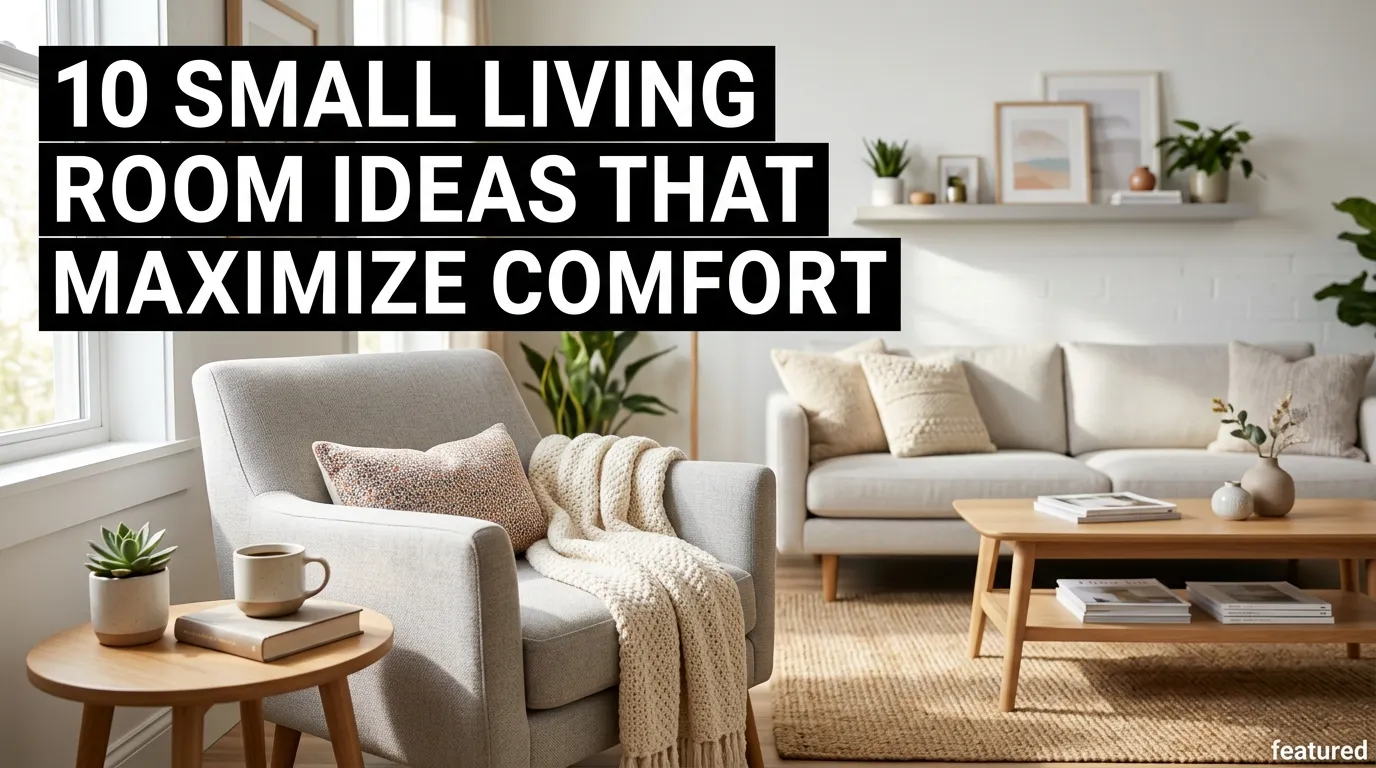
10 Small Living Room Ideas That Maximize Comfort
A small living room doesn’t have to feel cramped, unfinished, or difficult to decorate. In fact, some of the coziest living rooms I’ve seen are compact spaces where every piece has been chosen with intention.
The key is to stop thinking about what the room can’t fit and start thinking about what it actually needs. A comfortable sofa, useful lighting, a place to set down a drink, enough storage to control clutter, and a few personal touches can be more valuable than a room packed with furniture.
In my experience, scale makes a bigger difference than simply choosing small furniture. A petite sofa paired with an oversized coffee table can still make a room feel crowded, while a well-proportioned sofa, slim table, and carefully positioned accent chair can create a surprisingly generous seating area.
Color and texture matter, too. Soft neutrals can make a compact room feel airy, while layered fabrics, wood, woven materials, and warm lighting prevent it from feeling cold or overly minimal.
Whether you’re decorating an apartment, townhouse, rental, or small family home, these ideas focus on creating a living room that feels comfortable first and stylish second. The best part is that many of them don’t require a major renovation.
Think of these ideas as building blocks. Start with the layout, choose furniture that earns its space, then add lighting, storage, textiles, and personality.
Table of Contents
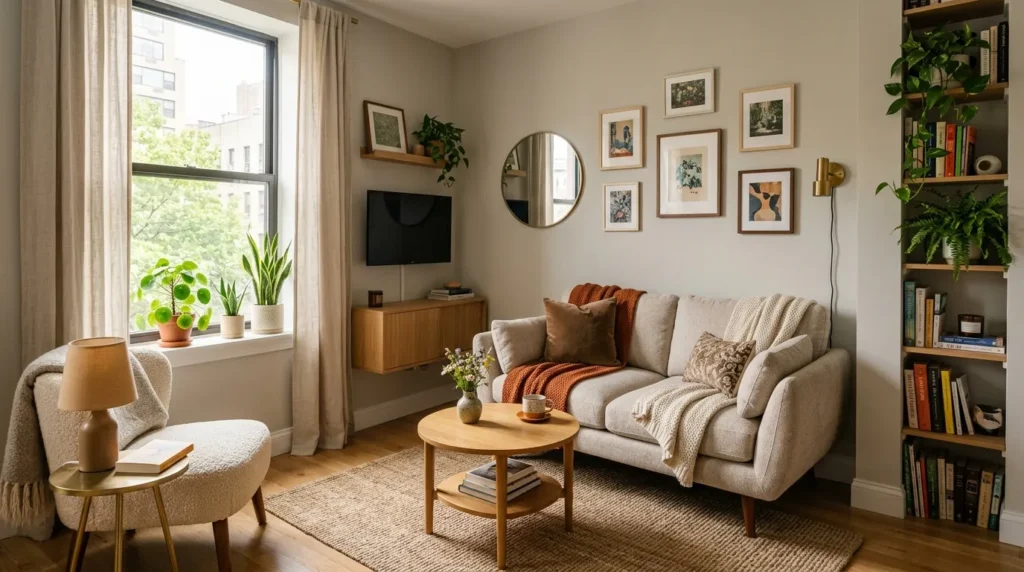
1. Apartment-Scale Sofa
Choose comfortable seating that fits the room without overwhelming it.
2. Floating Furniture
Pull furniture slightly away from walls to improve flow.
3. Storage Ottoman
Combine comfortable seating with practical hidden storage.
4. Light Neutral Palette
Use soft colors to create an airy, welcoming atmosphere.
5. Layered Lighting
Combine several light sources for a warmer, cozier room.
6. Vertical Storage
Use wall height to control clutter without sacrificing floor space.
7. Compact Accent Chair
Add extra seating without crowding the main sofa.
8. Large Area Rug
Visually anchor the room and connect the furniture.
9. Round Coffee Table
Improve movement while maintaining a useful surface.
10. Cozy Texture Layers
Bring softness and personality through textiles and natural materials.
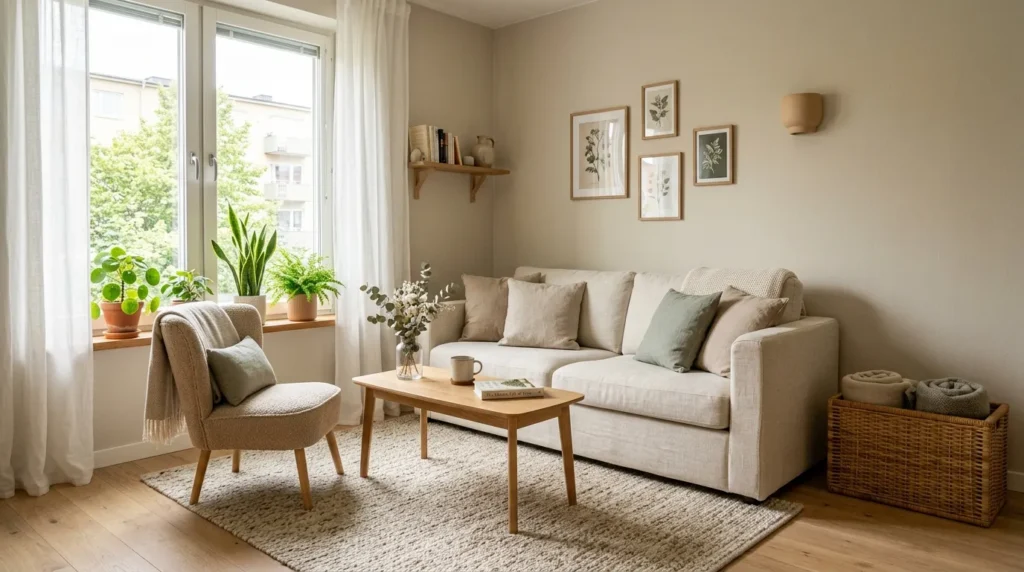
1. Apartment-Scale Sofa
Quick Benefits
- Creates comfortable primary seating
- Preserves walking space
- Works well in apartments
- Makes the layout feel balanced
- Provides a strong design anchor
Why It Works
The sofa is usually the largest piece in a living room, so getting its scale right can completely change how the space feels. A sofa that’s too deep or long can make a compact room difficult to navigate, while one that’s too small may leave the room feeling unfinished.
Look for an apartment-scale sofa with enough seat depth for comfortable lounging but a streamlined overall footprint. Arms that aren’t excessively wide can also preserve valuable seating space.
This doesn’t mean choosing an uncomfortable sofa just because it’s smaller. Comfort should remain the priority. The goal is to find the best proportion between generous seating and available floor area.
How To Style It
Position the sofa according to the room’s main focal point, such as a television, fireplace, window, or artwork.
If the room is particularly narrow, a sofa with a clean, simple silhouette can visually reduce bulk.
Add two or three cushions in complementary textures rather than covering the entire sofa.
A soft throw draped over one arm adds warmth without creating visual clutter.
Leave enough clearance around the sofa for comfortable movement.
2. Floating Furniture
Quick Benefits
- Improves circulation
- Defines the seating zone
- Can make the room feel intentional
- Prevents a boxed-in appearance
- Creates better conversation areas
Why It Works
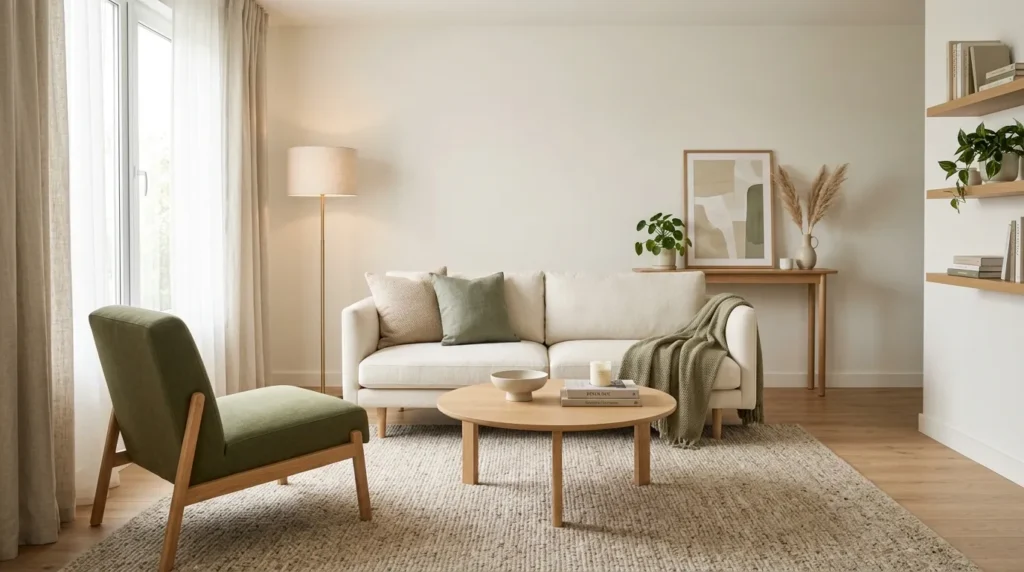
Pushing every piece of furniture directly against the walls can seem like the obvious solution in a small room, but it isn’t always the most comfortable arrangement.
Even pulling a sofa a few inches away from the wall can create a more intentional seating zone.
In some rooms, floating a chair or sofa slightly away from the wall makes the layout feel less rigid and improves circulation around the furniture.
The goal isn’t to create a huge gap. It’s simply to give the furniture enough breathing room to feel deliberately arranged.
How To Style It
Start with the largest piece and establish the main seating direction.
Place a coffee table within comfortable reach of the sofa while leaving enough clearance for people to walk around it.
If space allows, angle a compact accent chair toward the sofa.
Avoid creating narrow pathways between furniture.
For extremely small rooms, floating furniture may not be practical. In that case, use the same zoning principle while keeping pieces closer to the walls.
3. Storage Ottoman
Quick Benefits
- Provides extra seating
- Offers hidden storage
- Can replace a coffee table
- Adds softness
- Helps control everyday clutter
Why It Works
Multifunctional furniture is one of the most useful tools for a compact living room.
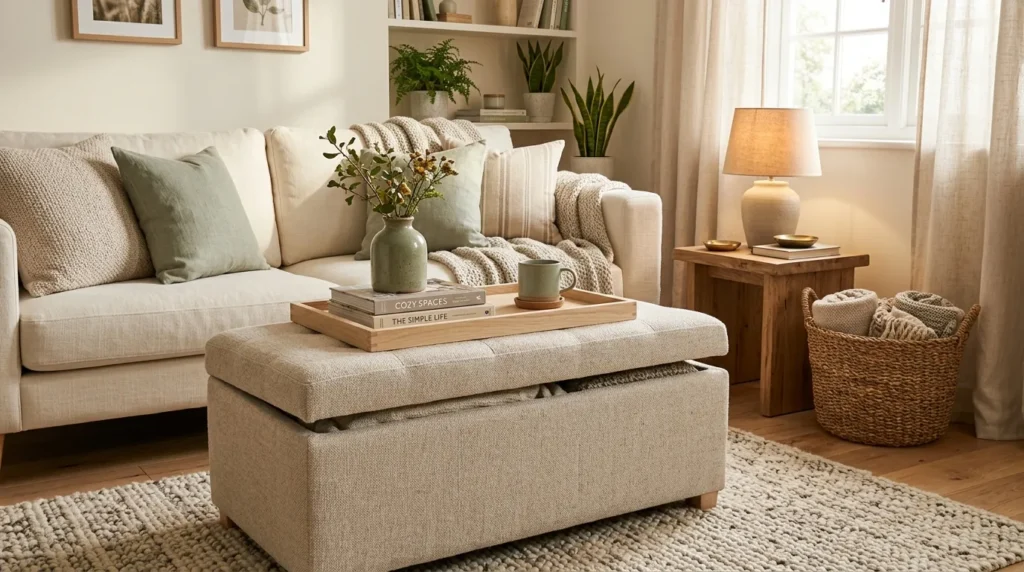
A storage ottoman can serve as a footrest, extra seat, coffee-table alternative, and hidden storage container.
That means one piece can accomplish several jobs without requiring additional furniture.
It’s especially helpful for households where blankets, books, children’s items, or entertainment accessories tend to accumulate in the living room.
How To Style It
Choose an ottoman that is proportional to your sofa.
For a soft, cozy appearance, look for upholstered options in performance fabric or another durable material appropriate for your household.
Use a decorative tray on top to create a stable surface for drinks, candles, or books.
Inside, store items that you want nearby but don’t necessarily want visible.
Choose a neutral fabric if your sofa already has a strong pattern, or use the ottoman as a subtle opportunity to introduce texture.
4. Light Neutral Palette
Quick Benefits
- Creates visual openness
- Makes decorating easier
- Reflects available light
- Feels timeless
- Works with many styles
Why It Works
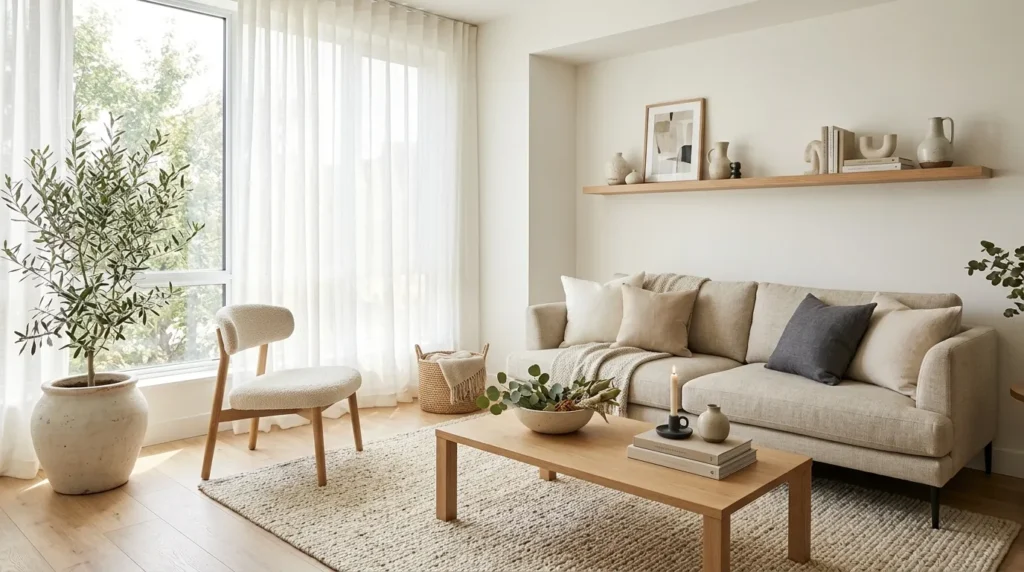
Color cannot physically increase the size of a living room, but a cohesive light palette can make the space feel more open and visually connected.
Warm white, cream, oatmeal, beige, soft taupe, and pale gray can create a calm foundation without making the room feel stark.
The important part is layering rather than making everything exactly the same color.
A room with several closely related neutral shades often feels richer than a room where every surface is identical.
How To Style It
Begin with one dominant neutral for the walls and larger furniture.
Then add two or three supporting shades through cushions, curtains, rugs, artwork, and accessories.
Natural wood is excellent for bringing warmth into a neutral space.
If you want more contrast, introduce small amounts of charcoal, black, muted green, terracotta, or dusty blue.
Keep stronger colors concentrated in accessories so they’re easy to change later.
5. Layered Lighting
Quick Benefits
- Creates a warmer atmosphere
- Makes the room more functional
- Adds visual depth
- Supports different activities
- Reduces reliance on overhead lighting
Why It Works
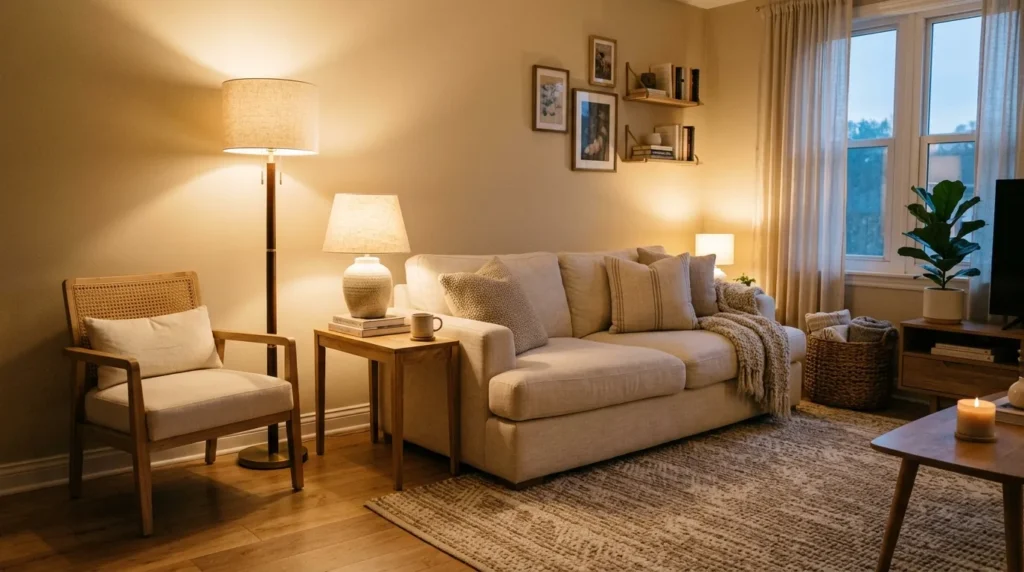
A small living room can feel surprisingly cozy when its lighting is thoughtfully layered.
One ceiling fixture often creates flat, uniform illumination. Multiple smaller sources create pools of light that make the room feel warmer and more inviting.
This is particularly useful in compact rooms because lighting can become part of the decor without taking up much floor area.
How To Style It
Combine a ceiling fixture with a floor lamp, table lamp, wall light, or portable rechargeable lamp where appropriate.
Place a floor lamp beside the sofa for reading.
Use a table lamp on a narrow console or side table.
Choose warm-toned bulbs appropriate for your fixtures and activities.
During the day, maximize natural light by keeping window treatments relatively light and uncluttered.
6. Vertical Storage
Quick Benefits
- Reduces floor clutter
- Uses unused wall space
- Creates display opportunities
- Keeps essentials organized
- Helps maintain a cleaner room
Why It Works
When floor space is limited, the walls become valuable real estate.
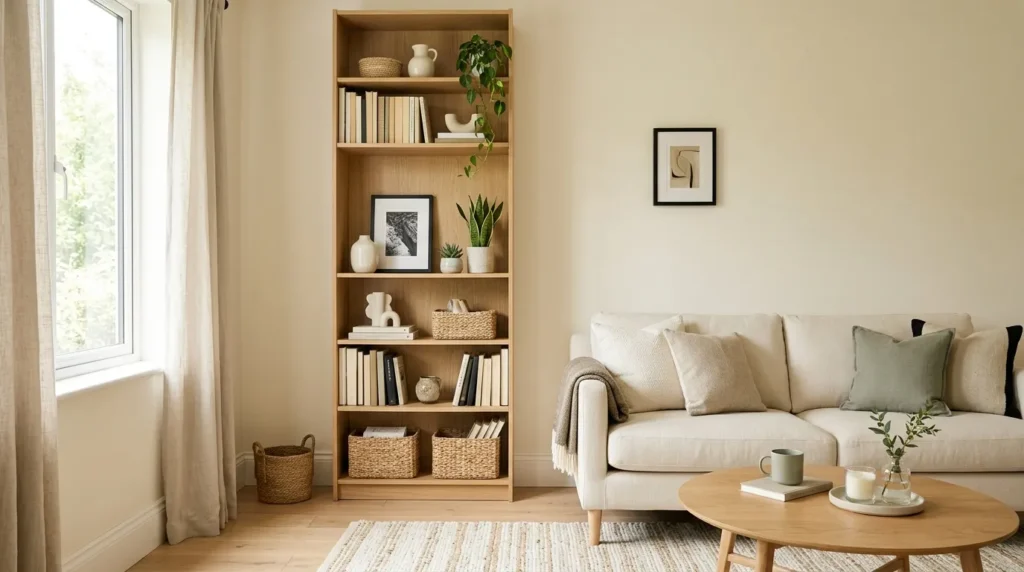
Vertical shelving, tall cabinets, wall-mounted storage, and narrow bookcases can provide substantial storage without requiring a wide footprint.
Going upward also draws the eye vertically, which can give the room a taller, more structured appearance.
The trick is avoiding overloading the shelves.
How To Style It
Choose one tall shelving unit rather than several small pieces when appropriate.
Use baskets to conceal smaller items and keep open shelves visually organized.
Mix books with ceramics, framed artwork, small plants, and decorative objects.
Leave some open space between groupings.
If you’re renting, consider freestanding storage rather than permanently mounted solutions.
Always secure tall furniture appropriately, particularly in homes with children or pets.
7. Compact Accent Chair
Quick Benefits
- Adds another seat
- Introduces personality
- Supports conversation
- Can fill an awkward corner
- Takes less space than a second sofa
Why It Works
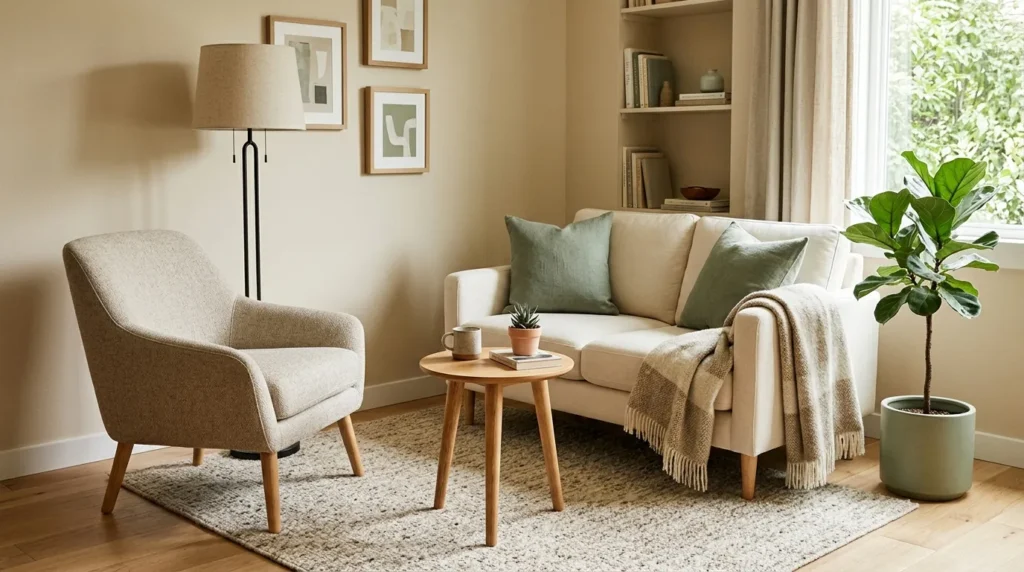
A second sofa can overwhelm a small living room, but one well-chosen accent chair can add valuable seating without creating the same visual bulk.
It can also introduce a new texture, color, or shape into the room.
A compact chair is especially useful when you occasionally host guests but don’t want permanent oversized furniture.
How To Style It
Choose a chair with relatively narrow arms and a footprint appropriate to the room.
Place it across from or at an angle to the sofa when possible.
If space is extremely limited, look for lightweight designs that can be moved when necessary.
A small side table beside the chair creates a practical spot for a drink or reading material.
Choose upholstery that complements the sofa rather than matching it exactly.
8. Large Area Rug
Quick Benefits
- Anchors the seating area
- Adds softness
- Connects furniture
- Introduces texture
- Creates a finished appearance
Why It Works
A common mistake in small living rooms is choosing a rug that’s too small.
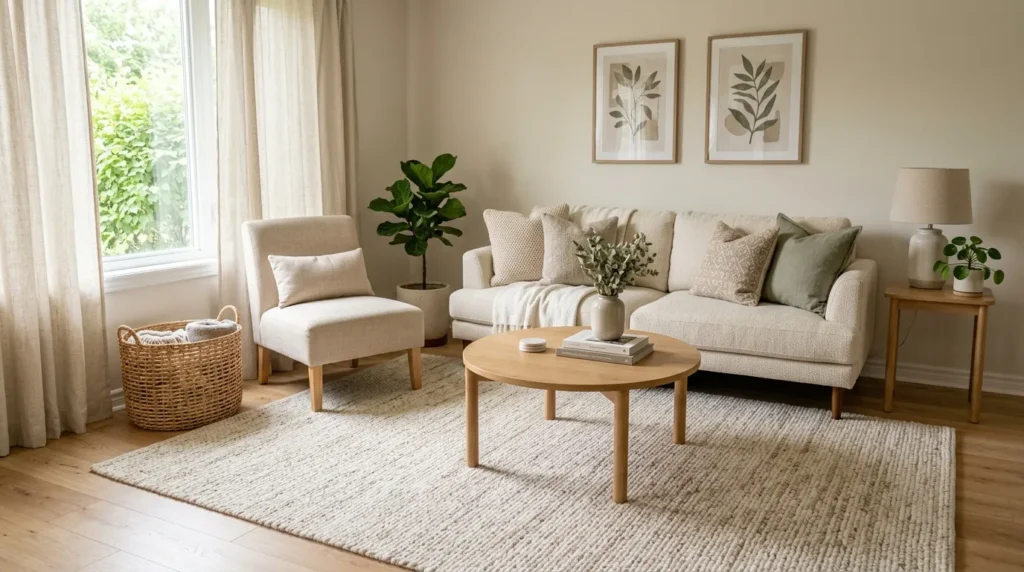
A tiny rug floating underneath the coffee table can actually make the furniture arrangement feel disconnected.
A properly scaled rug helps visually group the seating pieces into one cohesive zone.
It doesn’t need to cover the entire room. It simply needs to connect the main furniture.
How To Style It
Ideally, place at least the front legs of the sofa and accent chairs on the rug when the room allows.
Choose a low-pile design if you need doors to open over it or if you want easier maintenance.
Neutral patterns can add interest without making the room feel busy.
For a small room, avoid placing multiple unrelated rugs unless you’re intentionally defining separate zones.
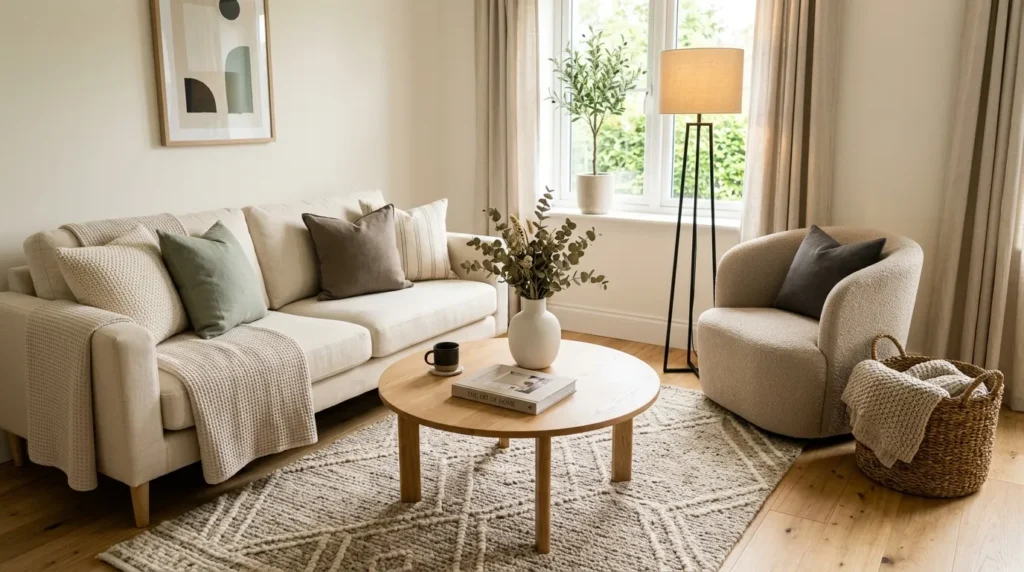
9. Round Coffee Table
Quick Benefits
- Improves circulation
- Eliminates sharp corners
- Creates a softer silhouette
- Provides useful surface area
- Works well in compact layouts
Why It Works
A rectangular coffee table isn’t always the most efficient option for a small living room.
A round or oval table removes corners that can interrupt walking paths and creates a softer visual transition between seating pieces.
This can be particularly helpful when the coffee table sits near a narrow walkway.
Round tables can also make a room feel less rigid because they introduce curves among sofas, chairs, shelving, and architectural lines.
How To Style It
Choose a table that’s appropriately scaled to the sofa and seating arrangement.
Wood creates warmth, glass can visually recede, and upholstered ottoman-style tables provide additional softness.
If using a hard tabletop, add a small tray to organize everyday items.
Keep the surface edited. A book, small vase, and decorative object may be enough.
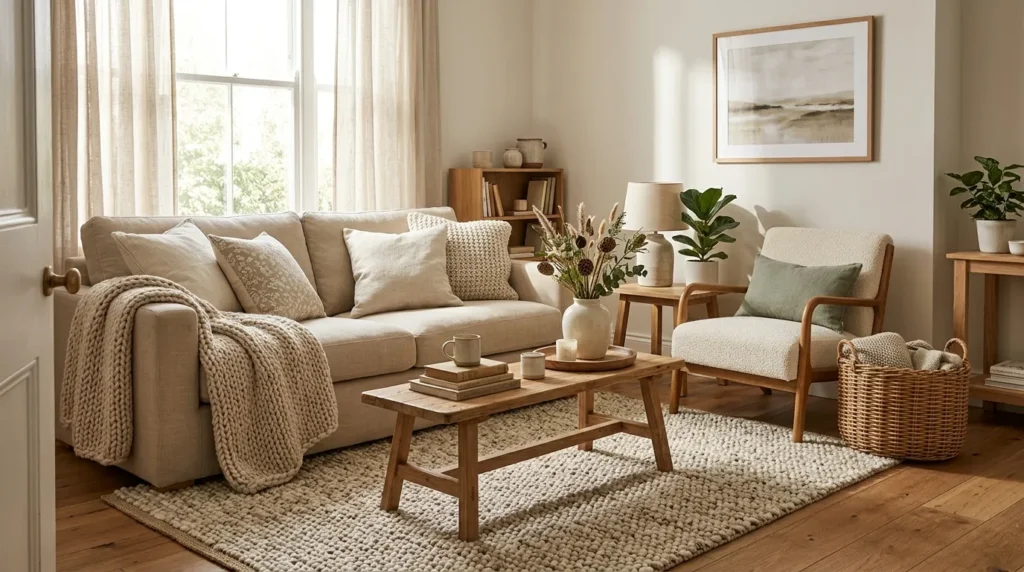
10. Cozy Texture Layers
Quick Benefits
- Makes the room feel warmer
- Adds visual interest
- Creates a relaxed atmosphere
- Works with neutral colors
- Makes simple furniture feel richer
Why It Works
Small rooms benefit from restraint, but restraint doesn’t mean everything needs to be plain.
Texture is one of the easiest ways to make a compact living room feel layered without filling it with decorative objects.
Linen, cotton, wool, boucle, wood, rattan, ceramic, and woven materials can create depth while maintaining a calm color palette.
This approach is especially effective when you want a cozy room without making it feel cluttered.
How To Style It
Start with a textured rug, then layer cushions in two or three complementary fabrics.
Add a soft throw over the sofa.
Introduce natural wood through a coffee table or side table.
Use a woven basket for storage and ceramic pieces for subtle contrast.
Keep the color palette consistent so the variety of textures feels intentional rather than chaotic.
How to Arrange a Small Living Room
Before buying furniture, measure the room—including doorways, windows, radiators, vents, and other fixed features.
Then identify the main focal point.
This might be a television, fireplace, large window, artwork, or architectural feature.
From there, establish the sofa position first.
Once the sofa is placed, determine where the coffee table and additional seating should go.
Try to preserve a comfortable walking route through the room rather than filling every open area.
A simple layout might include:
Sofa → Coffee Table → Accent Chair
with a rug underneath connecting the pieces.
If you need more storage, consider a tall bookcase or slim cabinet rather than adding another low piece of furniture.
Small Living Room Colors That Feel Cozy
A small room doesn’t have to be completely neutral.
Consider these combinations:
Cream + Warm Beige + Natural Wood
Soft and timeless.
Soft Gray + Ivory + Light Oak
Clean and contemporary.
Sage + Cream + Tan
Relaxed and organic.
Taupe + Dusty Blue + Warm White
Calm with subtle color.
Oatmeal + Terracotta + Dark Wood
Warm and earthy.
Choose one dominant color and repeat your accent shade in small doses throughout the room.
Small Living Room Mistakes to Avoid
One of the biggest mistakes is buying furniture before measuring the room.
Another is choosing too many small pieces because they seem easier to fit. Several tiny tables, chairs, baskets, and shelves can actually create more visual clutter than a few appropriately scaled pieces.
Avoid blocking windows with tall furniture whenever possible.
Don’t automatically push everything against the walls.
And don’t underestimate the importance of lighting. Even a beautifully decorated room can feel uncomfortable when it’s illuminated only by a harsh overhead fixture.
Finally, leave some breathing room. A comfortable living room needs space for people to sit, move, stretch, and live.
FAQ
How do you make a small living room feel comfortable?
Choose appropriately scaled seating, maintain clear walking paths, use a well-sized rug to anchor the furniture, and layer warm lighting. Multifunctional pieces such as storage ottomans can also reduce clutter while providing additional comfort.
What sofa is best for a small living room?
Look for an apartment-scale sofa with a comfortable seat depth, streamlined arms, and proportions that suit the room. Measure both the room and entry points before buying. The smallest sofa isn’t automatically the best choice; comfort and scale need to work together.
Should a rug be large or small in a small living room?
A properly scaled larger rug is often more effective than a tiny rug. Ideally, the rug should connect the main seating pieces, with at least the front legs of the furniture sitting on it when space allows.
How can I add storage without making my living room feel crowded?
Use vertical storage, multifunctional furniture, and concealed compartments. A tall bookcase, storage ottoman, slim cabinet, or storage bench can provide useful capacity while taking up less floor area than multiple separate storage pieces.
What colors make a small living room feel cozy?
Warm whites, cream, beige, taupe, oatmeal, soft gray, muted sage, and natural wood tones can create a comfortable atmosphere. Add small amounts of terracotta, dusty blue, olive, or charcoal if you want more personality.
Is a round coffee table better for a small living room?
A round or oval coffee table can be particularly useful because it eliminates sharp corners and can make movement around the seating area easier. Choose the shape based on the room’s layout and the space available around the table.
How do you decorate a small living room without making it cluttered?
Focus on a few functional pieces, repeat a cohesive color palette, and use texture instead of excessive accessories. Give every item a purpose, and leave some surfaces and wall areas intentionally open.
Conclusion
A small living room doesn’t need to do everything at once.
The most comfortable spaces usually start with a simple foundation: a properly scaled sofa, an easy-to-navigate layout, practical storage, and good lighting. From there, texture, color, artwork, greenery, and personal accessories can bring the room to life.
If your living room feels cramped, resist the urge to add more small furniture. Instead, consider whether one multifunctional piece could replace two or three separate items. A storage ottoman, tall shelving unit, compact accent chair, or round coffee table can make a surprisingly big difference.
Pay attention to scale, too. The goal isn’t to make every piece tiny. It’s to choose furniture that feels proportional to the room and comfortable enough for everyday life.
Start with the layout, then build gradually. Give yourself permission to leave a little breathing room around the furniture.
With the right proportions, warm lighting, layered textures, and a few thoughtful choices, even the smallest living room can become a place where you genuinely want to spend time.